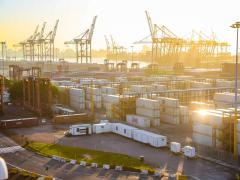
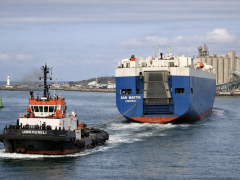
This week saw the launch of a Cairo-to-Cape Town free trade area (FTA) that’s bigger than the European Union (EU). This Tripartite Free Trade Area (TFTA) spans 26 nations in Africa, with a population north of 600 million, and was signed off on June 10 in Egypt. Although much of West Africa isn’t covered, the deal means a huge stripe of southern and eastern Africa will be. And, according to the Brookings Institute, this will cover 58% of Africa’s economic activity and over R12 trillion in gross domestic product (GDP). And the creation of this trade bloc is a positive step towards improved investment flow and the facilitation and flow of goods in the region, Jonathan Horn, MD of Maersk Line Southern Africa, told FTW. “This FTA,” he added, “will promote active trade between SA and the rest of the continent. “It will allow the enhancement of trade facilitation and improve the flow of goods in the region by reducing bureaucratic complexity, lowering transit times and the cost of trading.” But a fully up-and-running TFTA is not going to occur overnight, according to Duncan Bonnett, partner of trade consultancy, Liz Whitehouse & Associates, and an African trade specialist. “It’s still a long way off,” he said. However, he added, now is the time for SA companies to start taking a good look at the opportunities stemming from this FTA. “They need to look at it more holistically,” Bonnett told FTW, “and at how they can leverage the preferential trade agreements.” And he saw the main benefit for SA trade being greater access to the East African Community (EAC) – a five-nation geographical region covering an area of 1.8 million square kilometres, with a combined population of about 150m and a combined gross domestic product of over R3.6tn. “In the import basket in the EAC you’ll see big supplies from the Middle East and China,” said Bonnett. “And, if we get tariff preferences of say 10%-15%, we’ll be that much more cost-competitive. “From an SA import point of view, the same reduced import duties into this country would hopefully encourage local companies to import more from the EAC, such as coffee and tea, rather than importing from South America and South-East Asia.” Another promising event Bonnett highlighted was Ethiopia’s accession to the World Trade Organisation (WTO). This will increase that country’s trade volume due to the tariff reduction, also providing for a transparent and predictable regulatory framework, and prohibiting arbitrary and discriminatory restrictions on foreign trade. “It’s a country with a population of 90m (second biggest in Africa after Nigeria) and needs lots of imports,” he said. Horn however pointed out that although the region offered so much potential, intra-African trade links remained weak. According to research conducted by Ecobank only 12% of regional trade is conducted with other African countries. This is in comparison to Europe where 60% of trade is conducted with its own continent. “This highlights the opportunity to improve trade between SA and the rest of Africa, as well as how local companies can stand to benefit from exploring the region,” Horn added. “The TFTA will reduce risks associated with trade in the region and essentially make Africa an easier place to do business – an opportunity that SA companies should explore.” INSERT & CAPTION 1 The main benefit for SA trade is greater access to the EAC. – Duncan Bonnett INSERT & CAPTION 2 The FTA will reduce bureaucratic complexity, lowering transit times and the cost of trading. – Jonathan Horn
New FTA set to elevate intra-Africa trade
Comments | 0
© Now Media. This content is protected by copyright and may not be adapted or republished. If you would like to discuss cooperation opportunities, please contact: editor@freightnews.co.za.