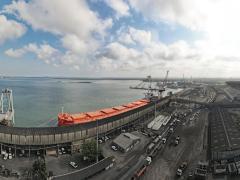
Moshe Motlohi is not about to deliver a prognosis without an examination - but the newly appointed terminal executive for Cape Town’s combined container and multi-purpose terminals is clearly under no illusion as to what lies at the heart of the problem. As serving business unit executive for Durban Container Terminal since early 2007, he is able to share with customers the ‘pain’ of port disruption from construction and inclement weather. And a carbon copy scenario is assured when he assumes duties as terminal executive in the Mother City port on January 1. His is clearly a reasoned approach – how to best come up with the necessary answers, but in order to do so, a first “look-see” is mandatory. “We have to look at what we have and what we should have, examine the gap between the two and work toward migrating where we should be. “We should have good, continuous feedback from customers. They need to be happy with us and we should take pride in creating value for them.” Motlohi believes the concept of merging terminals, as will be the case in Richards Bay and Durban, makes sound business sense. “The logic is to improve utilisation of Transnet Port Terminals’ assets and to ensure we give of our best.” He also assures whatever negative perceptions may exist about Cape Town Container Terminal will enjoy his undivided attention “because that is where it is all going to start.” Motlohi well understands customer frustration, sketching by way of example a vessel diverted at the 11th hour from one terminal to another. The new dispensation is intent on putting paid to such aggravation, bureaucracy and inconvenience through a single, combined staff complement of about 1 000 people. At the time of his interview with FTW on November 27, Motlohi had not yet engaged with his new staff but expects to do so at three sessions in early December. As to achievements in Durban, he says: “When I got there the terminal was doing 18 moves per crane per hour but we were up to 24 at the end of the previous (2008) financial year. “We also managed one of the biggest re-engineering projects within TPT, working with foreign (Sri Lankan) skills, a delicate one just to manage that environment to make sure the different cultures come together.”
New executive commits to solving CT’s problems
Comments | 0
© Now Media. This content is protected by copyright and may not be adapted or republished. If you would like to discuss cooperation opportunities, please contact: editor@freightnews.co.za.