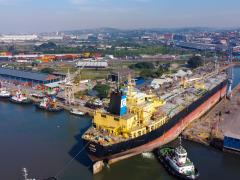
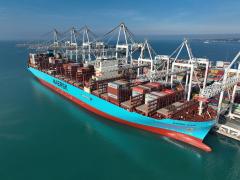
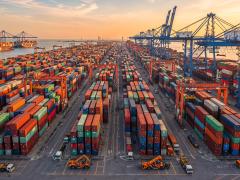
There’s a lot more than high port costs at play in the decline in transhipment (T/S) volumes at SA ports. The real issue, according to Iain McIntosh, regional sales manager – southern Africa at MOL South Africa, is liner networks and how they are structured. Referring to a recent FTW article (“High port costs drive away business” December 5, 2015) McIntosh believes this is not necessarily so. “Transnet Port Terminals (TPT) actually do have some flexible rates, depending on volume. However, in pricing terms, they are still expensive and more so when you factor in the concept of T/S globally (price, fast turnaround etc). And while a T/S hub does need to look attractive from a cost and speed point of view, it really does need to fit in with how a line runs its various networks, says McIntosh. This is demonstrated in the recent history of the SA transhipment business. Even prior to the arrival of Ngqura (which was principally set up as a T/S port), according to McIntosh, the transhipment volume in South Africa had grown dramatically between 2004 and 2006. It also took quantum leaps in 2010 and then again in 2011 (20% per annum) as Ngqura volume kicked in. But it has now largely settled into a lower pattern, even showing decline in 2014. There were two major changes recently – both related to line networks – which played significant roles in the SA transhipment scenario. “The rapid growth of Ngqura was largely driven by a number of MSC connecting services for East Africa, Angola, Mozambique etc, that built rapidly. The quantum leap in 2013 was caused by MSC introducing an SA-West Africa (WAF) large-size feeder product over Ngqura to cater for Asia-WAF flows which had previously hubbed over Valencia. “Conversely, a major dip – notably in Durban flows – was caused by CSAV after a massive reduction of four interconnecting services hubbing over Durban. “This was not the best place to hub given Durban constraints, and caused numerous problems for CSAV. “And, whilst Ngqura was designed for something like this, TPT had only provided limited access to the port in its early phase. The CSAV T/S product collapsed as a result and graphically so – hitting Durban with a 35% reduction in volume.” This limited access to Ngqura after its initial success actually damaged it by potentially overreaching and causing delays to hubbing, according to McIntosh. So much so,” he added, “that carriers started downsizing or withdrawing services.” MSC then exerted more downward pressure on SA T/S traffic with another change in its line network patterns. A re-shuffle of its Ipanema and Cheetah services into one service for SA indirectly shifted the large Asia-WAF transhipment operation back to the Med – although this is now handled by a direct product called Africa Express. “Ipanema also only calls at Durban westbound and that removed a significant volume of other T/S in Ngqura. A change that is shown in the decline of Eastern Cape volume in 2014.” Also, while Durban has shown an increase after its decline, this, according to McIntosh, is more to do with increasing T/S as a result of services feeding Durban-Cape Town. “That is,” he added, “local as opposed to international transhipment services. “And this will again decline now that MSC’s Africa Express has started calling at Cape Town en route to West Africa.” McIntosh also noted that the significance of this service spelled even wider implications for SA T/S volumes. “This service will only call at Lome Terminal in Togo,” he pointed out, “where a massive purpose-built hub terminal has been built with deep draught.” Also, the Africa Express uses the big 6 500-TEU vessels, and from Lome MSC will then run a series of feeders to other WAF ports. “This is volume now lost to SA,” McIntosh said. INSERT & CAPTION While Durban has shown an increase after its decline, this is more to do with increasing T/S as a result of services feeding Durban-Cape Town. – Iain McIntosh
Networks rather than cost drive transhipment decisions
Comments | 0
© Now Media. This content is protected by copyright and may not be adapted or republished. If you would like to discuss cooperation opportunities, please contact: editor@freightnews.co.za.