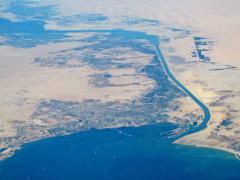
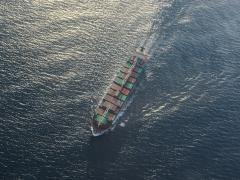
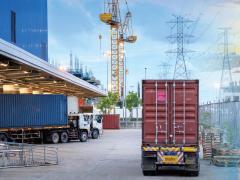
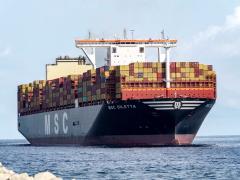
When asked for his predictions of the future of shipping, Ron Frick, MD of DAL Agency, suggested to FTW that such crystal ball gazing was pure speculation. “It has to be based on the trends we see today, and how they could develop further into the future,” he said. “This, of course, is pure conjecture.” But pushed to gaze, Frick added that the oversupply of container vessels was predicted to extend to 2016 or 2017. “This depends on the order book for new vessels being placed in 2013/2014, and this oversupply could be extended even further.” But he noted that alliances, such as the development announced by the Big Three container operators – Maersk, MSC and CMA-CGM – of the P3 alliance was an attempt to reduce the oversupply. “The three lines,” he said, “have agreed to establish a long-term operational alliance on East-West trades. The aim is to trim the number of vessels on their three routes by improving and optimising operations and service offerings. And it will be extended to the Trans-Pacific and Trans-Atlantic trades, if the model works on the Asia-Europe route.” An attempt to meet forthcoming emission control regulations, and reduce fuel usage and cost, is another must for the future, according to Frick. “We will undoubtedly see vessel, engine, fuel and container design making use of latest materials to reduce weight and improve fuel efficiency,” he said. “While at the same time they will be complying with the consumers’ and governments’ demands for a cleaner and safer environment.” The picture in his crystal ball also portrays a tightening-up of vessel and port security. Added to that Frick sees shippers having to take more responsibility for the accurate declaration of the weight and type of cargo they load into the containers. “This, with the benefit of X-ray technology, will eventually be verified and reported electronically as the cargo enters and leaves the ports.” Cargo tracking is also something that, in the relatively near future, will become even more sophisticated. Said Frick: “Container tracking devices will be on board every container, giving real time monitoring by means of geo-positioning.” The introduction of the ultra large container vessels (ULCVs), the likes of the Triple E class introduced by Maersk with 18 000 TEU capacity, and bigger in the future, will lead to landside problems. “The ports they call at will have added strain on inland infrastructure,” said Frick. “This will be in terms of container handling facilities and the ability to move the volumes loaded and discharged by the mega ships into the hinterland effectively by rail, road and barge or a combination of the three modes. “These challenges will be solved through major investments in ports and infrastructure development.” Frick also sees a consolidation of the number of ship operators in the future. This as the global economy fails to keep pace with the growth in vessel capacity. “This,” he said, “will possibly lead to some casualties, as the banks that finance these vessel and container assets become more risk-averse.” Added to this, according to Frick, is the impact of politics on the future of shipping. “Any hostilities, for example, in the Middle East or Central America could affect the safe passage of vessels through the Suez or Panama canals,” he said. Elsewhere, it might not have such a throttling effect on sea trade, but Frick could not disagree with the fact that politics running wild can have an adverse effect on the free flow of seafreight, and on the insurance needed to protect it against the extra costs incurred. INSERT & CAPTION Container tracking devices will be on board every container, giving real time monitoring by means of geo-positioning. – Ron Frick
More alliances, bigger vessels, greater consolidation ...
Comments | 0
© Now Media. This content is protected by copyright and may not be adapted or republished. If you would like to discuss cooperation opportunities, please contact: editor@freightnews.co.za.