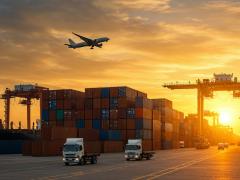
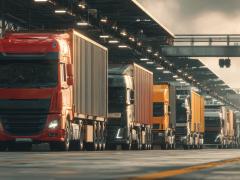
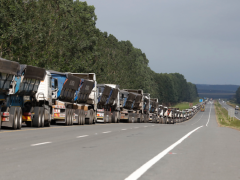
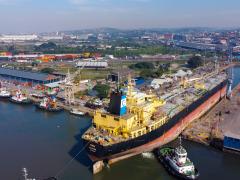
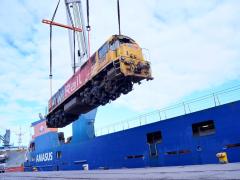
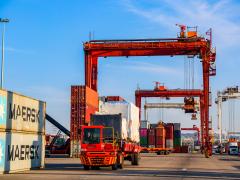
For mining companies in Africa, the single biggest headache when setting up is logistics. In many cases, the mines are located deep inland, but infrastructure like rail, and often even decent roads, is rudimentary, often non-existent. Mining companies have to make peace with the fact that most of their capital spend in the construction phase of a mine in Africa will be to create a railway and port facilities. Bulk commodities, like iron ore and coal, are particularly challenging. “You can move bulks by truck, but most of it is done by rail to be more economical and efficient,” a logistics consultant said. A lot of the new iron ore projects are in West Africa. However, logistics in this part of the continent is still underdeveloped and the task falls to the mining companies to build the infrastructure. “Iron ore is not a mining game, it’s one of infrastructure,” Benedikt Sobotka, MD of consulting firm Bryanston Resources, said. “Even a sub-quality deposit still has a chance to be developed if you have a chance for infrastructure,” ArcelorMittal Liberia’s Joseph Matthews, head of government and community relations, said. He noted that ArcelorMittal’s iron ore deposit in Liberia was “not such a great deposit”, but infrastructure in the country made development possible, even if the rail that exists close to the steelmaker’s deposit required substantial rehabilitation. ArcelorMittal Liberia expected the first phase of its mine’s development, which included the 250-km rail line’s rehabilitation, to be around $1 billion. However, Matthews said it soon became apparent that the cost would be closer to $2 billion, because of the capital the company had to spend on rehabilitating the 250-km rail line that runs from the mine to the port. Similarly the Sundance Resources project, straddling the borders of Cameroon and Republic of Congo, estimates it will need about $4.7 billion to build its mine. Of this amount, the infrastructure cost would take up more than half of the capital. Building a 510-km rail line to the west coast port would cost just over $2 billion, while the port construction would come in at $537 million. Mining companies further south face similar challenges to the companies higher up in Africa. Coal miners in Mozambique are battling to find partners to share the cost of developing rail infrastructure in the country. Brazilian conglomerate Vale, which has the Moatize mine in Tete, has suffered a far-belowtarget output from its mine in 2012 as a result of a delay in the expansion of the existing Sena rail line, which transports coking coal from Moatize to the port of Beira. Vale expected to produce 6.37 million tonnes of coal at Moatize in 2012, but has between January and September only produced 2.8 million tonnes. The mine can produce 11 million tpy and wants to expand production to 22 million tpy in the second half of 2014. However, the lack of infrastructure could hamper the company’s ambitions. Restrictions on the Sena line and Beira’s limited access for larger cargo vessels have motivated plans by Vale to build a 1000-km rail line from Moatize through Malawi to Nacala, where Vale will also seek to build a port. The cost of the project is estimated at $4.4-5.2 billion. Unsurprisingly, Vale’s CFO Luciano Siani said in December last year that the company was seeking a partner for the Nacala corridor development to share costs. Other companies have similar plans. Kazakh miner ENRC plans to start a tender process for contractors to build its own, privately funded 1200-km rail line, also to Nacala. However, none of these projects will fly without funding. INSERT ‘Even a sub-quality deposit still has a chance to be developed if you have a chance for infrastructure’ – ArcelorMittal CAPTION Mining companies must accept that most of their capital spend in the construction phase of a mine in Africa will be to create a railway and port facilities.
Mines in Africa need deep pockets to finance infrastructure development
Comments | 0
© Now Media. This content is protected by copyright and may not be adapted or republished. If you would like to discuss cooperation opportunities, please contact: editor@freightnews.co.za.