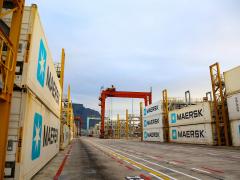
The Association of Meat Importers and Exporters of South Africa (Amie SA) is pushing for the creation of a risk-based sampling system for the testing of poultry and meat imports at the Port of Durban. Two years since Amie filed court papers on the Department of Agriculture Forestry and Fisheries (Daff) to contest the implementation of acrossthe-board testing of all raw frozen poultry and meat imports entering South Africa's ports, random sampling remains in place, according to newly appointed Amie CEO Paul Matthew. The association has suggested a phased approach to the risk-based system which would see available data sorted on historical performance and a lower sampling requirement applied to the top 50% of ‘lower risk’ export production facilities. Closer surveillance would be applied to the next 40% (suspect facilities) while the bottom 10% would be subject to 100% surveillance. Amie has proposed a three- to six-month interim period after which the results would be considered and the facilities regraded depending on the outcome of the test phase. “The ‘highrisk’ facilities can be moved depending on the results to ‘low risk’, or ‘suspect facilities’ can be upgraded to ‘low risk’ if performance improves,” said Matthew. In November last year, Daff ’s Veterinary Public Health (VPH) in conjunction with Amie’s technical experts came up with a system to analyse the VPH data on imports. The idea was to pilot the risk-based sampling system at the Port of Durban. “It was also agreed, as an interim measure, that Daff VPH would propose some relief on the current level of microbiological sampling in order to allow Amie members some reprieve on import inspections, especially taking into account the expected high levels of activity of the December period,” said Matthew. While Daff management had issued an instruction to the ports at the end of last year, this did not go according to plan, he added. “Amie members had some relief on the current level of microbiological sampling, however issues around laboratory results and policy process from Daff ’s side led to an unnecessary re-sampling process, resulting in product delays in meeting the Christmas poultry demand.” Delays from inspection services are sometimes up to three weeks, leading to product build-up in the cold storage which has a huge impact on the logistics chain. “Food safety is a priority for us and we want to ensure that imports are of a high standard,” said Matthew who believes riskbased sampling would be fairly straightforward to implement. He is encouraged by progress made by the citrus industry. “They have resolved issues on the export side and we believe that lessons learnt can be applied to imports. Industry commentators have suggested that there could be more at play in Daff ’s insistence on blanket inspections – and that protection of local industry may be a factor in the department’s intransigent stance. FTW was awaiting comment from Daff when this issue went to print.
CAPTION
An unnecessary re-sampling process resulted in product delays in meeting the Christmas poultry demand. – Paul Matthew