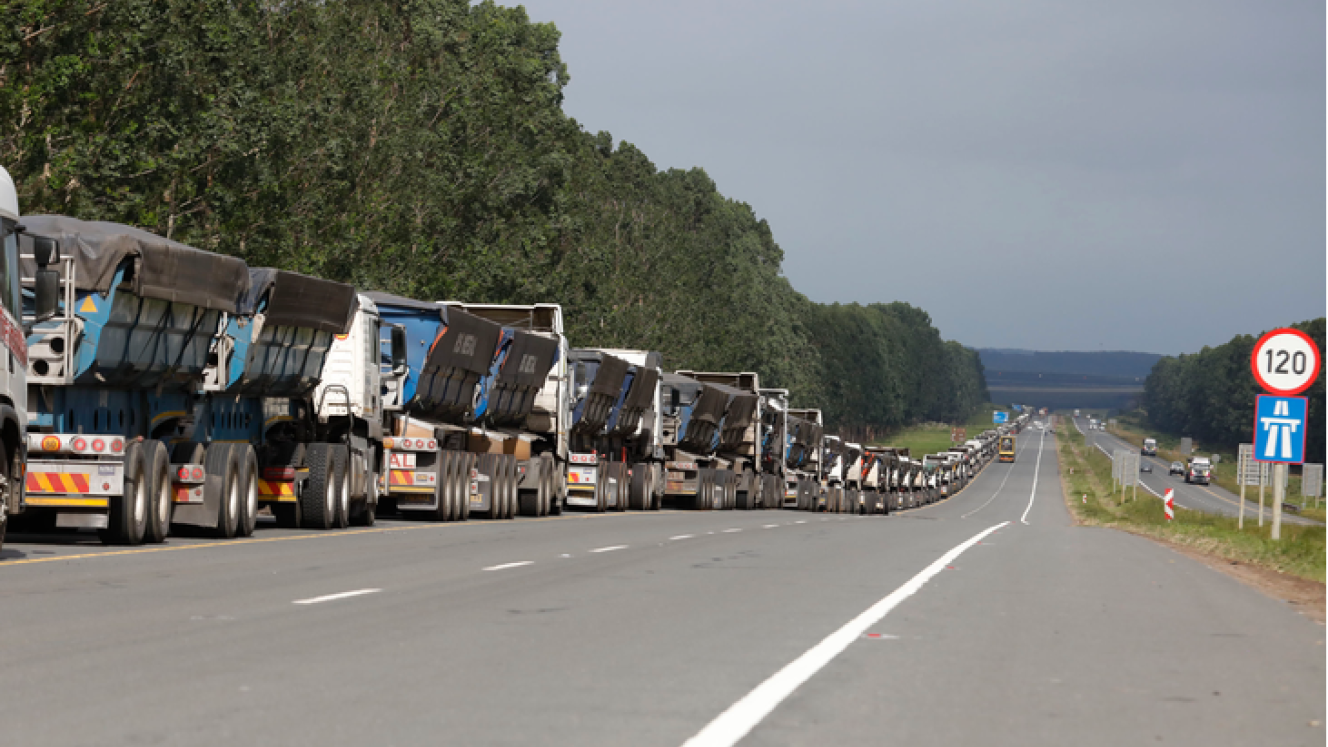
At least 65 000 transport industry workers this week returned to work following a week-long strike marred by violence and intimidation. The Road Freight Employers’ Association and the four unions – the SA Transport and Allied Workers’ Union (Satawu), the Professional Transport Workers’ Union (PTWU), the Transport and Allied Workers’ Union of SA (Tawusa) and the Motor Transport Workers’ Union (MTWU) – on Sunday signed an agreement in principle on wage increases and other demands. The final agreement to end the strike was due to be signed as this issue went to press on Monday morning. Workers downed tools on February 13 after negotiations had already deadlocked in December last year. Demanding a 20% across-the-board increase for the next two years, unions on Sunday agreed to the revised offer. “We believe we have achieved our goal and will advise our members to be back at work by no later than Tuesday morning,” said Satawu general secretary Zenzo Mahlangu. “We have gained major ground during this strike as the employer significantly increased its offer.” With the RFEA only offering a 7.5% increase for 2011, the final agreement of 9% for 2011 and 8.5% for 2012 is being heralded by unions as a major victory, while a 13th cheque will now be paid to all union members in December as well. On the contentious issue of labour brokers – unions were demanding they be banned from the industry altogether – Mahlangu said they were extremely happy with the agreement reached that would see a 30% reduction in the use of labour brokers in the next two years. “We understand that labour brokers cannot be banned altogether, but we are happy with the employers’ commitment to seriously reduce the use of labour brokers in our industry.” Reckson Baloi, general secretary of the PTWU, agreed. “A task team will be appointed to ensure that we reduce the use of labour brokers. We will take up this and other issues when we return to the negotiating table after two years.” He and Mahlangu said the strike had for all intents and purposes brought the RFEA to see things from the workers’ perspective. “It is sad though that we have to strike in this industry before we can come to an agreement,” said Baloi. “In other sectors agreement is often reached without striking. Yes, we achieved our goal with the strike, but as an industry we should be able to resolve our problems and issues more quickly. Striking is always a last alternative and it happens when employers are not committed to finding a solution.” The strike, however, was marred by incidents of violence and intimidation with several truck drivers, who continued to work, being hospitalised after being attacked. In some instances trucks were set on fire, vehicles forced off the road and cargo looted. Said Mahlangu: “We do not condone the violence and don’t expect this to happen. There may have been incidents, but it was involving people who were carrying on their deliveries during the time of the strike.”
Major victory for workers – Satawu
Comments | 0
© Now Media. This content is protected by copyright and may not be adapted or republished. If you would like to discuss cooperation opportunities, please contact: editor@freightnews.co.za.