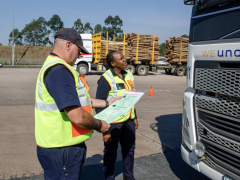
Serious concerns about the lack of legal-technical certainty over who the legitimate inspectorate authority is to vet vehicle testing stations were raised at a recent presentation by the National Regulator of Compulsory Specification (NRCS). Following an address to members of the Johannesburg Chamber of Commerce and Industry (JCCI) by the regulator’s CEO, Edward Mamadise, an open-floor session sparked heated discussion when a member of the motoring industry took the NRCS on about what seems to be high-level bureaucratic bungling. According to Ivan le Roux, who identified himself as “a long-standing member of a technical committee” involved with vehicle testing, there is still no clear confirmation
from the Department of Transport about whom the mandated authority is to police testing stations – the NRCS or the South African Bureau of Standards (SABS). Le Roux said that since 2008, when the Standards Act had become law, “there was a lot of ducking and diving by the SABS regarding the appointment in writing by the then ministers of transport” about who the legitimate inspectorates of testing stations were. He said that during that time vehicle documents had been issued by people who
were not allowed to do so. “It got so bad at one stage that pop-up stations connected to the eNaTIS system were registering vehicles that were bodies (scrap) lying out in the veld.” Le Roux added that persistent inquiries by the Retail Motor Industry (RMI), among others, not only showed that the “SABS lied to its technical committee members from 2008 to 2015”, but eventually led to a class action suit by the RMI. As a result the SABS “declared a non-conformance” whereby testing work it had done dating back to
2008, before the Standards Act came into play, was withdrawn. “As such it has left South Africa in a situation where they (the SABS) don’t deal with any regulatory issue or the enforcement of regulatory issues such as vehicle testing stations.” Le Roux stressed that because the situation had been allowed to persist, it had created a kind of legal limbo because “we effectively don’t have a technical inspectorate appointed by the minister of transport”. Trying to control the situation on behalf of Mamadise, Patrick Corbin of the International Chamber of Commerce asked that questions not be confrontational. Le Roux though insisted that he receive a response and implored Mamadise to confirm whether or not the NRCS was legally mandated
to oversee testing station verifications. Mamadise explained that they had a letter confirming the legitimacy of the NRCS as the legal inspectorate for the motor industry but the document in question had an SABS letterhead and that it dated back prior to the regulator’s split from the bureau in September 2008. Le Roux shot back saying “it’s the very letter that has caused the mess because it’s not legal”. He said it was the same document that applied to the SABS “divesting itself of the powers to police things as prescribed under law”. Mamadise undertook to clear up the matter. He added though that the relevant documentation vouching for the regulator’s inspectorate legitimacy was confidential and would only be published on the NRCS’s website once their attorneys had given the go ahead to make it public.
CAPTION:
It got so bad with the testing stations that pop-up stations connected to the eNaTIS system were registering vehicles that were scrap lying out in the veld. – Ivan le Roux