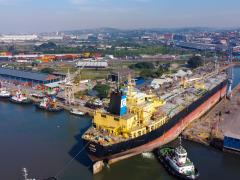
One of the more important issues facing the maritime industry in Durban, from a long-term perspective, is whether the land previously occupied by Acsa as the Durban International Airport will be preserved in a usable condition for a future digout Superport. The question has been tossed around for several years and in fact goes back as far as the 1950s when a proposal was made to extend a channel from the Port of Durban all the way through Clairwood and Merebank suburbs to link up with the Umlaas Canal, which had recently been cut through the Bluff to drain the area for Durban’s then new airport on Reunion Flats. Quite what the purpose of the lengthy canal or passageway would have been has never been explained, but the concept of a new port to the south persisted and was resurrected in the mid 1990s during the huge debate over creating a new container terminal on Durban Bay’s central sandbank. More recently Transnet Capital Projects took up the idea as part of its vision for Durban in the so-called Transnet Infrastructure Plan, a new name for the Port Master Plan of old. From this came a workable concept of digging out a wide and deep basin along the area used as the main runway at the old airport. The airport has been relocated to the north of Durban. Land on either side of this dug out basin would become container stacking yards for a new container terminal, and facilities would also be created for a number of tanker berths capable of handling VLCC vessels in addition to a separate facility for a car terminal – the huge Toyota manufacturing plant being adjacent. Transnet has never stated categorically whether this new port – for that is what it would be rather than an extension of Durban – will be built but the infrastructure plan points the way forward once the present port is considered to have been fully developed. In 2009 Tau Morwe, then CEO of Transnet Port Terminals, indicated that Transnet was having discussions with the city, with Acsa and with the KwaZulu-Natal provincial government on future plans for the old airport site and how best to utilise this prime land. One of the key advantages is that the new port is situated right next to the N2 highway and would avoid complicating further traffic congestion in the current port and CBD area. That the city sees it this way was made evident at a public meeting held at the end of May when city manager, Dr Mike Sutcliffe, addressed the issues of the proposed dig-out Superport. It became clear the city was strongly in favour of this option and would not stand in the way of it becoming a reality in the future. Sutcliffe made a strong plea for the property to be integrated into a new Superport and emphasised the need for long-term planning. Acsa, which is the legal owner of the land, not surprisingly wants to sell the site as soon as possible. The airports company has an urgent need for cash to pay for having been told by government to build the new King Shaka International Airport. While initially indicating its interest, Transnet subsequently advised Acsa that it would not be making a bid for this land. Instead Transnet says that it has proposed to the Department of Public Enterprises that, due to the strategic nature of the land, consideration should be given to retaining it under government control for possible future portrelated development. Transnet’s current approach is meanwhile to sweat its assets at Durban as far as is possible, with an extension to Pier 1 Container Terminal into the Salisbury Island land the most likely next step. The company has almost completed a programme of relocating workshops and staff parking to enlarge the existing stacking area while options exist to extend the capacity of DCT by means of vertical expansion at some point in the future. This would require converting the terminal to a rubber tyre gantry-type operation and allowing for container stacks of up to five high. Another option available to Transnet is to utilise part of the City Terminal more fully as a container terminal. Container handling is already under way here, using ships’ own gear and a mobile crane. The fact that the City Terminal has the port’s deepest berths – 13.4m alongside – is another advantage. These options together with the economic downturn make any decision to dig out the airport site for a new container superport a long-term option for Transnet. The problem is that the airport site is now available, with Acsa desperate to sell it – but the timing is not right for Transnet to look too closely in that direction.
Is the dig-out port on or off?
Comments | 0
© Now Media. This content is protected by copyright and may not be adapted or republished. If you would like to discuss cooperation opportunities, please contact: editor@freightnews.co.za.