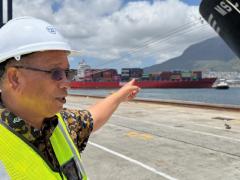
An ongoing slump in the economy has forced a change in the way transporters and clearing and forwarding agents do business. “Business is no longer driven by contracts, trust or mutual collaboration. Services are contracted on an ad hoc basis,” said Viz Naidu, managing director of Intermodal Freight. He told FTW that Intermodal Freight was focusing on its core strengths to compete in an increasingly competitive environment. “We have been in business since 1992 and have earned credibility in the marketplace as a hands-on, 24/7 business. It may currently be a ‘dogeat- dog' business environment that is purely ratesdriven, but I believe that trust, collaboration, experience and credibility will win out in the end,” Naidu commented. He added that it was easy to get a client, especially with low rates. “But it is harder to retain that client, especially if all the business is based on is cheap rates.” Niren Naidu, Intermodal Freight director, pointed out that while the large conglomerates took the lion’s share of the business in South Africa – often because clients had burnt their fingers with fly-bynight companies – smaller, independent companies had the edge in the personalised service they can offer. To stay competitive, Intermodal Freight is looking at establishing stronger partnerships with agents in Europe, said Naidu. “We have great agents in Asia, the Far East and the United States and we’ve seen that in the growth of our business to and from these areas. Europe is turning around economically and strong agents will help us gain ground,” he said. Naidu agreed that Africa was a strong emerging market that every agent and transporter was pursuing but added that while the company was doing business on the continent – with demand growing for mining supplies and perishables, amongst others – Intermodal Freight’s main focus remained South Africa. “We are also looking at growing airfreight in and out of SA, particularly looking at consolidated loads to save costs for our clients,” he said, explaining that while seafreight was cheaper, it took longer. “If we can manage smaller, consolidated loads via airfreight we can keep the costs down and meet tight deadlines,” he commented. INSERT Niren Naidu and Viz Naidu
International focuses on stronger European agency ties
Comments | 0
© Now Media. This content is protected by copyright and may not be adapted or republished. If you would like to discuss cooperation opportunities, please contact: editor@freightnews.co.za.