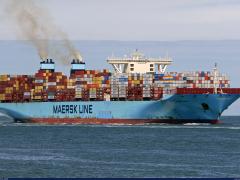
With the world’s largest container ships currently rated as 19 000-TEU capacity, the question remains: How big can they get? The average size of boxships has been increasing dramatically by around 5.5% a year. And the history of the evolution of these vessels has displayed this. In the period 1956-70 the early container ships (converted from other classes of vessels) carried 500-800 TEUs. The early cellular ships in 1970- 1980 ranged from 1 000-2 500 TEUs. In 2013 the Maersk Triple E vessels emerged, carrying a maximum capacity of 18 270 TEUs, and this last month we have seen the 19 000-TEU vessel, CSCL Globe, being named. She is the first of five such vessels ordered by China Shipping Container Lines (CSCL). The ship is 58.6m wide and 400m in length with a draft of 30.5m. However, even before she was launched the shipping industry was already talking about 21 000-, 22 000- and 24 000- TEU ships, although none of these has actually been ordered. And, if you want to beat this, you may even listen to talk of the Malaccamax class of vessel, which would carry 30 000 containers. She would run aground in the Suez canal, but would just pass through another bottleneck of international trade – the Strait of Malacca, between Malaysia and Indonesia. There is no real limit to what can be built and safely sailed on the world’s oceans, as long as the depth of the ocean is sufficient to take the draught (depth) of the vessels without them grounding. So FTW approached three local shipping experts with the question: How much bigger will/can they get and what about the overcapacity situation? And all three – Jonathan Horn, MD southern Africa at Maersk Line; Glenn Delve, SA marketing director of MSC; and one who wished to remain nameless, but suggested being referred to as “the ancient mariner” – agreed. It’s not the Seven Seas, but the very maritime infrastructure that will set the limit, they said. Both Delve and the ancient mariner talked about insurance and safety issues, inshore ocean depths, harbour depths and the maximum reach of ship-to-shore (STS) cranes. Moving up to the possible 24 000-TEU capacity vessel would need larger cranes, reinforced berths, bigger turning basins, deeper water and investment in landside infrastructure such as road and rail connections. Port congestion being seen this year in Europe and now Asia is a possible sign of infrastructure problems already starting to appear. And, as Delve put it, there is also a limit to the size of vessel you can operate and still gain economic advantage, due to all these other costs and operational limitations. The ancient mariner pointed out that marine architects had worked out that the depth of container tiers in the cargo hold was restricted by the fact that a maximum of 11 containers could sit one on top of each other. More than that and the bottom box is likely to collapse. “It’s very difficult to give a definitive answer as to how big vessels can get,” said Horn. “This depends on a number of factors such as ship design and material technology. “Indeed, also landside infrastructure and draught limitations will play a role as to how big and at what pace this size evolution will occur.” Horn also noted that driving improvement in cost economies of scale and improved environmental performance were significant factors behind the industry desire to increase vessel size. “The overcapacity question,” he added, “is not an easy or one-dimensional answer. “Supply and demand balance is and has been an issue on the major East-West trades. Injecting additional larger vessels into these trades in the absence of a significant recovery in demand – or indeed cascading, scrapping or laying up of currently deployed tonnage – will obviously have some impact on the balance or overcapacity situation. “But cascading of tonnage can have a similar supply-anddemand impact on trades to which tonnage is cascaded.” So, the answer at the moment is that infrastructure constraints could put the brakes on further growth in ultra large containership sizes even if they are technically possible. And although bigger ships give the lines lower slot costs, infrastructure costs and constraints could be starting to outweigh the benefits of even bigger boxships. CAPTION The 18 000-TEU Maersk McKinney Moller … soon to be eclipsed.
Infrastructure could scupper big-ship plans
Comments | 0
© Now Media. This content is protected by copyright and may not be adapted or republished. If you would like to discuss cooperation opportunities, please contact: editor@freightnews.co.za.