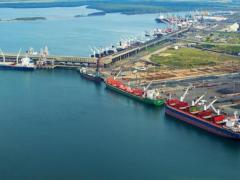
SHIPPING AND logistics group Grindrod is expanding its footprint in Africa in its various roles as ships operator and agents, clearing and forwarding agents, project cargo managers, warehouse operator, port and terminal operator and railway operator in-and-around the southern sub-continent. An example of its overborder activities is the 12% stake Grindrod holds in Maputo Port Development Company (MPDC), operating the main port in Mozambique which – with an annual cargo throughput of 6.6-million tonnes – now handles more ships and trade than the ports at Dar-es-Salaam, Beira, Port Elizabeth or Cape Town. Grindrod has already invested some US$25-m (about R177.15-m) in the port and intends to invest a further US$80-m (R567-m) over the next three years. Included in this is a 95% ownership of the Maputo coal terminal, where phase 1 of the development programme will bring the terminal to a throughput capacity of 3.5-m tons by end- 2007. Grindrod also owns the Maputo car terminal, due to be completed in December and with an initial annual throughput capacity of 63 000 cars, to be ultimately increased to 250 000 cars. It is also funding the expansion of the ferrochrome slab, as it is expected that the export of ferrochrome will increase over the next few years – an increased demand that has already started, according to international press reports. The Moma project, a contract won by Röhlig Grindrod in 2005, is now nearing completion. The project involved a US$220- m mineral-sands processing facility being developed in the remote and completely unserviced area inland of the coastal village of Moma, approximately 650-kilometres north of Beira. In its guise as a railway operator, Sheltam Grindrod is now established in Zimbabwe, Mozambique, Zambia, Malawi, Swaziland, Botswana, Namibia, and Democratic Republic of the Congo (DRC) – and owns and operates the largest privately owned fleet of mainline locomotives in Southern Africa. Sheltam Grindrod also has a fully developed aviation operation which includes air charter for executives travelling to various African countries. Noting the huge demand for sulphur in “the Copperbelt” in Zambia and DRC, Grindrod Terminals has contracted to handle the bulk of it through, Richards Bay, Maputo and Dar es Salaam. As part of this, the group established Grindrod Tanzania Limited (GTL) in Dar es Salaam in July this year – with the sulphur movement as prime objective. Within a year, GTL will also be moving sulphur to the huge uranium mine at Kayalekera in north-eastern Malawi, and will also handle associated bulk products (such as lime). Grindrod Terminals is also developing its API Holdings terminal company Walvis Bay bulk terminal (WBBT) in Namibia – and has just taken on an additional 18 000m2 of bulk storage land area from the port authority, Namport. This is adjacent to the current terminal’s storage yard and is being rehabilitated and prepared to ISO 14001 standards. Another subsidiary, Atlas Trading and Shipping, has a joint-venture in Malawi, acquiring between 25 000 and 30 000-metric tonnes of grains, oilseeds and pulses a year – cleaning, grading and re-bagging the products for supply to mostly NGOs in Malawi along with exports to neighbouring countries.
Industry major expands African footprint
Comments | 0
© Now Media. This content is protected by copyright and may not be adapted or republished. If you would like to discuss cooperation opportunities, please contact: editor@freightnews.co.za.