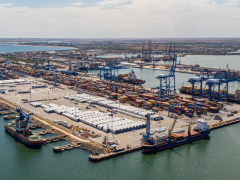
Namibian freight volumes are largely determined by the economies of its land-linked neighbours – and its competitiveness as a trade gateway. Once it has overcome the inevitable teething problems the new Walvis Bay container terminal will provide importers and exporters with a modern new gateway capable of handing increased volumes of containers, bulk and breakbulk. “Our feeling is that the impact along these corridors will not be immediate, however over the medium term I think that there will be an increase of volumes flowing from Botswana as well as Zambia and the DRC – especially given the fact that Walvis is a deep port,” says Gerhard van Zyl, group operations director of the Professional group of companies. There are already new players in the form of hauliers, shipping lines and logistics companies that have established a presence in Walvis Bay in order to cater for the expected increase in commodity exports and imports of mining supplies. Much, therefore, depends on the health of the neighbouring economies. The elephant in the room is South Africa, which has an economy that is expected to remain in the doldrums. In addition, the Trans Kalahari Corridor joining Gauteng to the port of Walvis Bay has failed to gain traction for a number of reasons. This may change if Namport makes the most of the temporary opportunities that will be created when work starts on the Durban container terminals. Van Zyl believes volumes may
well shift to Walvis Bay. “The other deep port harbours are not keeping up with demand. Namport has most definitely seized the gap. I have no doubt that the volume to Walvis will increase and there will eventually be a decrease in Durban specifically.” Supporting growth in Walvis Bay volumes is a much more positive outlook for the other Southern African Development Corridor (SADC) neighbours than that for South Africa. The World Bank estimates that Zambian real GDP growth
rose to an estimated 4% in 2018, compared with 4.1% in 2017. Copper increased by an estimated 4%-4.5% in 2018. There has been a direct effect on Namibian volumes. According to the Walvis Bay Corridor Group (WBCG), 450 000 tons of transit cargo moved through Walvis Bay to Zambia in 2018 – an increase of 51% from 2017. The good news is that “the medium-term outlook remains positive, with growth projected at 4.2% in 2019 and 4.3% in 2020. However, lower demand from China is expected to further
dampen the copper price, which fell by more than 18% in 2018. The Zambian government may kill the goose that lays the proverbial copper egg by increasing mining taxes in order to make up shortfalls in tax collection. There is also an expectation that the Democratic Republic of Congo will continue growing, at around 4.5% in 2019 and 4.6% in 2020, according to the World Bank. Mining should remain the key driver of growth. Putting the lid on growth is the DRC’s “infrastructure deficit”. Manufacturing and mining are the two drivers of economic growth in Botswana, which recorded a real GDP growth of 4.2% in 2018, up from 2.4% in 2017. “Growth prospects for the medium term are favourable, with real GDP growth projected at 3.8% in 2019 and 4.1% in 2020. “The outlook for the mining sector is positive due to an anticipated increase in demand for Botswana’s rough diamonds,” says the World Bank. Zimbabwe’s economy continues to puzzle analysts. “The economy performed better than expected in 2018, expanding by an estimated 3.5%, driven by agriculture, supported by relatively peaceful elections. Despite the headwinds, the economy is projected to grow by 4.2% in 2019 and 4.4% in 2020.
Health of its neighbours will determine logistics growth
Comments | 0
© Now Media. This content is protected by copyright and may not be adapted or republished. If you would like to discuss cooperation opportunities, please contact: editor@freightnews.co.za.