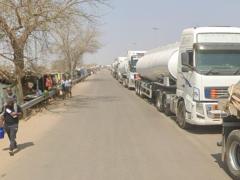
Would banning trucks from driving at night cut back on the number of accidents, and more importantly in the case of accidents involving trucks, the SA accident death rate? Behind this question lies the fact that, six months after Kenya’s National Transport and Safety Authority (NTSA) banned night time driving for public service vehicles (PSVs), it claims to have recorded a reduction of 50% in road accidents. A primary answer to the original question would be: Of course it would lead to a considerable cut in truck accidents. But that would be due to the fact that you would have taken a huge number of trucks off the road for the X hours a night that you would have the ban. That same argument arose regarding the Kenyan exercise. A transport consultant in Kenya said: “When you effectively reduce the operating time for buses by half, it is only logical that road accidents involving buses will reduce by half. “The overall reduction in road accidents – when you include all non-PSV vehicles – is about 20%.” But such a ban would certainly cut out the peak time for driver fatigue, according to Carl Webb, MD of Project Logistics Management, and a member of the Road Freight Association (RFA) abnormal transport committee. “The UK’s Royal Society for the Prevention of Accidents, in its extensive study on driver fatigue and road accidents, found that sleep-related accidents peaked in the early hours of the morning, between 02:00 and 06:00,” he told FTW. “They calculated that drivers are 50 times more likely to fall asleep at the wheel at 02:00 than at 10:00.” So driver fatigue is an important factor, he added. And the other trucking specialists FTW quizzed on the issue also rejected the theory for a number of reasons. A main one of which, and expressed by Gavin Kelly, technical and operations manager of the RFA, is: “It would have a huge impact on the logistical process in this country because a huge amount of freight moves at night, especially on the country’s main freight route, the N3 Gauteng- Durban highway.” Garth Bolton, joint CEO of the major haulier, Cargo Carriers, is equally anti-ban. “I would certainly argue against it,” he told FTW. “Obviously, in a lot of instances, operations are double-shifted (one driver for day and another for night driving). That’s especially true for perishable cargoes, where there is urgent need to get them to the markets on time, while still fresh.” Bolton also stressed a cost factor. “It would push up costs for truckers, who would not be getting full vehicle utilisation,” he said. “And the consequence of increasing the price of the transportation of goods would therefore push up prices in general.” He noted that it would also probably hit the day-time accident rate. “More trucks then being on the road could increase accidents during the day, and cause even more congestion.” Barney Curtis, CEO of the Federation of East and Southern African Road Transport Associations (Fesarta), also suspects that the whole story about the Kenyan situation hasn’t been told. “I think that Kenya has been pretty tough on enforcement in recent years,” he told FTW. “And that has as much to do with the reduction in accidents as the ban on night driving.” INSERT & CAPTION To meet SA’s transport demands, trucks need to drive at night. – Barney Curtis CAPTION Banning night driving for trucks is not feasible in South Africa.
Hauliers slam night-time ban
Comments | 0
© Now Media. This content is protected by copyright and may not be adapted or republished. If you would like to discuss cooperation opportunities, please contact: editor@freightnews.co.za.