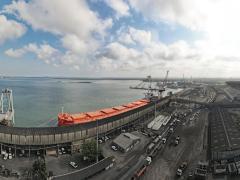
As the first ever rapid rail system for Africa and one of the biggest infrastructure projects in South Africa, Gautrain has become a symbol of pride, prosperity and progress for the continent. The extent of the emotional connection of the South African people with the project was clear when, with the arrival of the first rail car on African soil at the end of 2008, not only did workers at the Port of Durban come to a standstill to look but motorists would stop to move out of the way of the abnormal load on the roads giving it right of passage. With the system set to be operational between OR Tambo International Airport and Sandton by June this year, Gautrain is changing the face of transport in the country forever. But getting the massive rail cars into the country was not easy. The project, which involved 81 cars “flat packed” and crated into the country from Europe and 15 fully assembled railway cars imported, demanded careful planning and execution. The Gautrain system, which consists of 24 train sets, each consisting of four cars – a total of 96 cars – saw 15 of the railway cars constructed and assembled at the Bombardier Transportation manufacturing facility in Derby in the UK before being transported to South Africa. The remaining 81 cars were locally assembled at the premises of Union Carriage and Wagon Partnership in Nigel following a skills transfer programme with the UK. Once assembled they were moved by road to the Midrand depot. According to Dan Hope, service introduction manager for Bombardier Transportation, who has been involved with the project since 2007, planning and more planning was crucial to the success of the project. “Bringing the 15 cars home was a job of note, but one which made me realise how emotionally involved people are with the Gautrain. People stopped on the highways to watch the heavy procession going past, giving them right of way, hooting and waving. It really was spectacular to watch and be part of it.” After the 15 cars were constructed in Derby they were loaded onto a trailer and transported in twos by road from the workshop to Immingham harbour on the east coast of the English midlands and then by sea to Antwerp.” From Antwerp the cars travelled by sea to Durban where they were carefully loaded onto a specially designed trolley system and moved by road to Midrand in Gauteng. “With each car measuring in at 21 metres in length and weighing 46 tonnes, the transportation was not a small feat. Throughout the entire process, communication between the various role-players was extremely important,” says Hope. A project of such enormity meant that everyone had to be committed to ensuring success. “From the shipping line to the transportation company there was always a very good working relationship,” says Hope. “Ultimately the different project managers had to be in constant communication with each other to stay on top of what was happening and also to ensure that everything was running smoothly.” Shipped by Maritime Carrier Shipping and road-hauled by Vanguard transport, the 15 cars have since arrived at the Midrand depot where for the past few months they have been vigorously tested for quality and safety. “Another reason why this project was so successful is that there were plenty of pre-meetings to ensure everyone knew exactly what was expected of them and that all aspects of the project were always covered,” says Hope. Despite all the planning it was, however, not always smooth sailing – an inevitable reality of project cargo. “Firstly the rail cars are awkward sizes and that proved difficult in the loading and unloading phases – especially at the port, which is not necessarily set up to receive large trains. Another pr oblem we ran into was that most of the bridges on the N3 were too low to accommodate the abnormal load, so the trucks had to be re-routed and the trip from Durban to Midrand finally comprised a distance of some 1200km.” But experience and knowledge proved key, says Hope. “We found after the first run that we had a much better idea of what to expect and also how to cope with any problems and issues. We are extremely proud of this project as it really has been an extraordinary journey.”
Gautrain’s extraordinary journey ends with a universal thumbs-up
Comments | 0
© Now Media. This content is protected by copyright and may not be adapted or republished. If you would like to discuss cooperation opportunities, please contact: editor@freightnews.co.za.