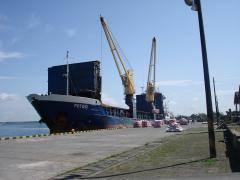
EFFORTS TO address cut-price milk imports at diplomatic level rather than through trade remedies like antidumping legislation appear to have paid off for the local dairy industry. Latest statistics point to an increase of R9.00/kg in the average price at which milk powder was imported between June and July 2007 thanks to lobbying by the Milk Producers’ Organisation, but the reasons for the anomaly remain a mystery. When it first manifested earlier this year, the MPO met with senior managers of the International Trade Administration Commission (ITAC). According to organisation MD, Etienne Terre’Blanche, the MPO noted that free-on-board (fob) prices of some milk powder imports were on average US$1 300 (R9 282) per ton below the accepted world price. “The main sources of these goods were Uruguay, Australia, New Zealand and to a lesser extent, Argentina,” he added. It all couldn’t have happened at a worse time, according to MPO’s international trade manager, Barbara Bieldt. “Our dairy producer members have gone through a tough time since 2004, and a lot went out of business because producer prices were so low.” This saw the MPO membership dwindle from 4 300 in 2004 to 3 800 at the moment. “The small to medium sized farmers really suffered,” Bieldt added, “although things started recovering at the beginning of this year.” But then the deluge of cut-price milk powder imports entered the scene. "It looked as though these low-priced imports were going to come in and destroy the whole local industry again,” said Bieldt. So serious was the threat that the MPO now took the matter on to the diplomatic front – hoping that cooperation at consulate level might find answers to the problem. This saw communication flowing between the MPO and the local embassies for Argentine, Ireland, Australia, New Zealand and Germany. “Ireland, Argentine and Germany responded quickly,” said Bieldt, “and representatives from the embassies told us “they regretted” that low price milk powder imports had come from their countries. “This especially at a time when there was an international shortage of dairy products, and prices should actually have been on the rise.” The Argentinians and Germans are still investigating the matter, but Ireland has already come up with an explanation. According to the Irish Dairy Board, some of their exports had been prepriced for future delivery – at prices which were below the international norm at the time of actual export. In its own investigations, the MPO has already ruled out the possibilities of dumping or under-invoicing as being behind the cut-price imports. “We are still not entirely clear about all the reasons,” said Bieldt, “but it’s certainly not under-invoicing. The import tariff for milk powder is R4.50/kilogram, so there’s no incentive for under-invoicing. It’s not an ad valorem duty.” But the MPO’s decision to look at diplomatic discussion rather than trade remedies – like taking action against dumping and the subsidisation of dairy products – seems to have been the right move. He described these latest figures that indicate more expensive milk powder imports, as “pleasing”. “It appears as if the price of imported milk powder is stabilising in accordance with international tendencies,” he added.
Flood of cheap milk imports confounds the industry
Comments | 0
© Now Media. This content is protected by copyright and may not be adapted or republished. If you would like to discuss cooperation opportunities, please contact: editor@freightnews.co.za.