The Western Cape
government has set
its sights firmly on
the creation of a
halal food manufacturing
hub that will boost the
local economy to the tune
of more than R1 trillion
and create no fewer than
5 000 jobs.
Having commissioned
a study – which includes
a full analysis of the halal
industry, mapping of
potential opportunities,
and the evaluation of
three proposed sites
for the building of the
industrial park – minister
of economic opportunities,
Alan Winde, is confident
that 2017 will see some real
movement.
“The results of this study
will become available
shortly. They will allow
us to assess supplier gaps
and aid us toward growing
participation in this
industry that we believe
will significantly boost
the Western Cape,” he told
FTW.
With the goal to grow the
value of the halal market
from less than 1% to 2%
by 2025, Winde and his
team have already put in
place a range of initiatives
to increase the province’s
share of this global market.
“This is a market with
huge potential,” said
Winde. “Globally this
sector is expected to grow
by 6% by 2020. The global
Muslim market spent $142
billion on travel in 2014,
and this figure is expected
to reach $233 billion by
2020. The halal food sector
is expected to grow by 5.8%
by 2020, with the demand
for ethical treatment of
animals alone resulting in
a $100-billion organic food
market.”
From a broader
perspective, ongoing
efforts have seen South
Africa become one of the
five largest producers of
halal products worldwide.
The halal industry in South
Africa is estimated to be
about $3.3 billion.
Winde is adamant the
Western Cape can pull a
large share of this and can
only benefit from tapping
into this market. “Part of
our strategy to increase
our share of the global
market is the potential
development of a halal
park,” he said. “The
park would be a cluster
of manufacturing and
service firms in the halal
industry. It will present
significant opportunities
for private sector
investment. The feasibility
of this is central to the
study which is just about
complete.”
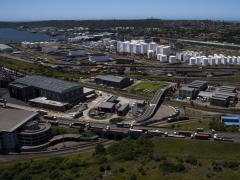
Three sites are being
investigated as locations
for the park – Stellenbosch,
Klapmuts and the Cape
Town International
Airport. The park would
ultimately be a central
space for manufacturing
and service firms in the
sector as well as a single,
globally recognised halal
certifying body.
“While we are waiting
for the findings of the
feasibility study, we
are working on other
initiatives to grow our
footprint in this market.
This year we have allocated
R1.7 million to promote
Western Cape halal
exports to new markets,”
he said.
Wesgro, through existing
trade promotion activities,
will also facilitate the entry of
Western Cape companies into
foreign markets with the aim
of increasing their exports by
50% over a two-year period.
Winde said several key
markets had been identified
already as presenting great
opportunities for Western
Cape companies, from both
a political and economic
perspective. These include
Saudi Arabia, United Arab
Emirates, Iran, Qatar,
India, Pakistan, Bangladesh,
China, Indonesia, Thailand,
Singapore, Cameroon, Egypt,
Malaysia, Morocco, Nigeria
and Sudan.
Findings of halal park feasibility study imminent
Comments | 0
© Now Media. This content is protected by copyright and may not be adapted or republished. If you would like to discuss cooperation opportunities, please contact: editor@freightnews.co.za.