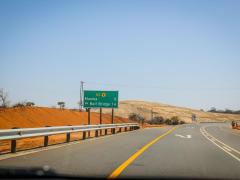
Plans should be finalised in April for the more than R1.34-billion Kazungula Bridge linking Botswana and Zambia. It will replace the notoriously unreliable Kazungula pontoon ferry across the 400-metre-wide Zambezi River. In August 2007 the governments of Zambia and Botswana announced a deal to construct a bridge at the site to replace the ferry, and the draft final report was submitted on December 15 last year. According to a progress report from the Southern African Development Community (SADC) forwarded to FTW by Barney Curtis, executive officer of the Federation of Eastern and Southern African Road Transport Associations (Fesarta), the final detailed design report is ready to be considered and approved by the second week of April – and the donors’ conference due to be staged by May. The new bridge will replace the extremely unreliable ferry operation currently serviced by two 70-tonne capacity motorised pontoons operating between the border posts at Kazungula, Zambia and Kasane, Botswana – and reckoned to be one of the largest ferries in southcentral Africa. It’s a geographically pivotal point on the map of Southern Africa, with the territory of four countries (Zambia, Zimbabwe, Botswana, and Namibia) coming within a few metres of meeting at the common point of Kazungula. It is also pivotal from a road transport point of view. The Kazungula ferry/ bridge location links the Livingstone-Sesheke road (which connects to the Trans-Caprivi Highway at Katima Mulilo and forms part of the Walvis Bay Corridor) to the main northsouth highway of Botswana through Francistown and Gaborone to SA, and also to the Kasane-Victoria Falls road through Zimbabwe. It serves the international road traffic of three countries directly (Zambia, Zimbabwe and Botswana) and of three more indirectly (Namibia, SA and DR Congo). The bridge design configuration is “extra dosed” low cable stayed and the estimated construction period is 48 months. According to Curtis, the border facilities will be onestop border posts (OSBP) – in line with the regional guidelines in the SADC Protocol on total cost management (TCM). Funding is to be through sovereign loans, and – after construction and three to five years of operation to assess the traffic levels – it will then be decided whether to go for a lease or concession.
Final design of Kazungula bridge ready for approval
Comments | 0
© Now Media. This content is protected by copyright and may not be adapted or republished. If you would like to discuss cooperation opportunities, please contact: editor@freightnews.co.za.