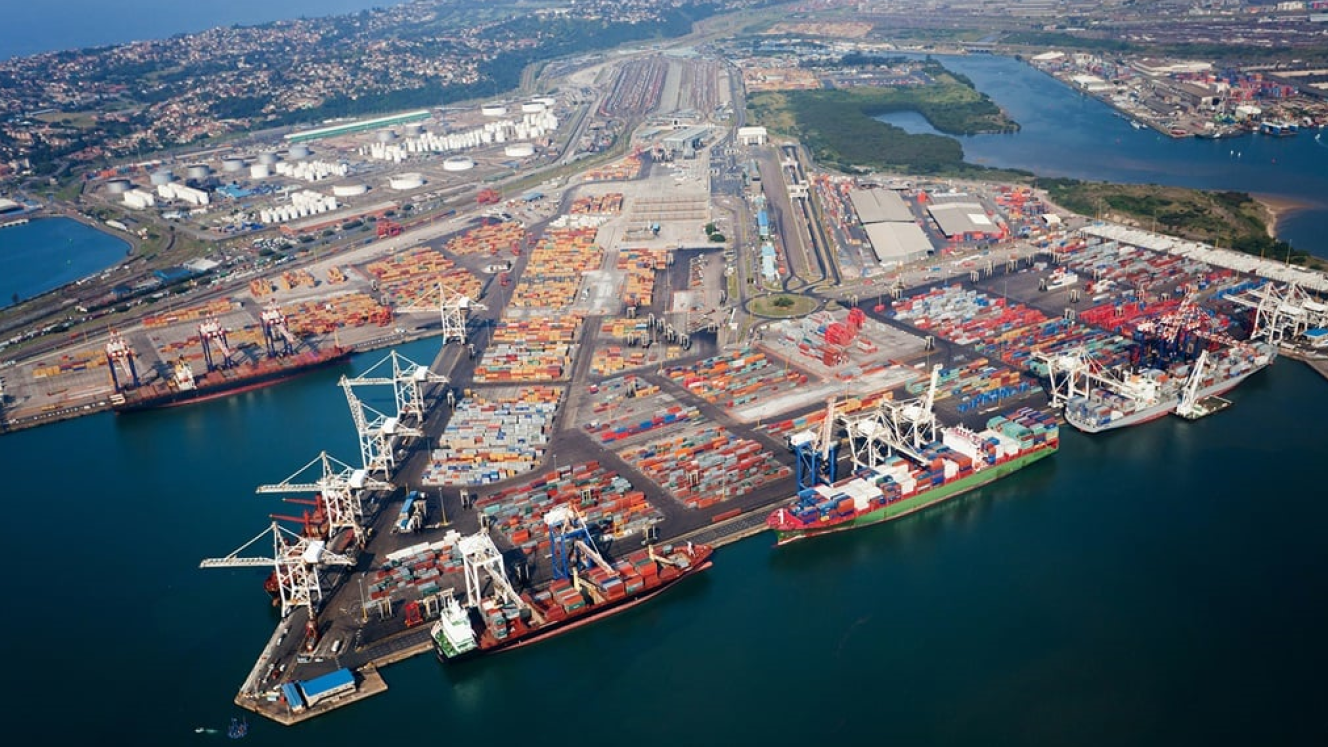
Dropping through 'break-even' floor Alan Peat THERE ARE distinctly creaky noises coming from the shipping line community on the SA-Far East trade, as freight rates hit the lowest of the low. "Profitless pricing" was how one line executive put it to FTW, while another complained about the "below break-even" rates, and the "very unhealthy" state in which this left the industry. While July 1 saw a general rates increase (GRI) of US$100 per twenty-foot equivalent unit (TEU), "that's still below break-even," complained the second source. Looking at export rates, both confirmed US$200-250/TEU as the going rate to all main ports in SE Asia, with imports at US$550 although "a common rate ex Hong Kong is US$400", said one. In the 1999-2000 trade year Ð "when there was a compatible balance between supply and demand", FTW was told Ð there were "fairly good rates", with exports in the region of US$800/TEU and imports at US$1 150. Trend The trend since then, according to the executives, has been one of the trade becoming increasingly overtonnaged and rates dropping through the break-even floor. This after the old Safari consortium (or "ship-sharing agreement" as one of the traditional member lines always puts it) had split up. An event which spun off three new operations all fighting for a share of the Far East trade. This was P&O Nedlloyd and MOL; Safmarine and Maersk forming the new Safari set-up, with MSC joining them as another big operator; and the third combine between K-Line, MISC and PIL. "And all of them with bigger ships than they had before," said one of the FTW commentators. Which means, for those without services continuing to South America (where rates are much higher than SA) to balance their capacity income, or without goodly shares in the automotive industry freight movements as a base cargo, the times are tough. "A lot more pigs snuffling at the same size trough," was how one executive phrased it. While some lines are claiming up to 90% capacity usage, most are likely to be in the 50%-70% range, according to the executives FTW interviewed. That's well below the strange measure in the industry Ð that "80% is ship-full". And at less than break-even rates it's an evil-tasting concoction for the lines. But, said the two executives, there is another GRI "in the pipeline". However, at the same time, there is a feeling expressed by our two commentators Ð and agreed by others Ð that what the lines need is people to stop cutting prices. Either that, or place their "bottom of the rates" price at a higher level. "What needs to happen is that they (the price cutters) take, say, US$350 as their bottom mark for exports, and US$550 for imports," said one source. "We can still go for our higher rates, but at least we'd know that we weren't getting cut to ribbons." The other is even more adamant. "The minimum requirement should be US$550/TEU," he said. Both suggested that this would become a main subject of conversation wherever and whenever line executives meet. "It's a very unhealthy situation for all concerned and it's difficult to see how it can be sustained."
Far East rates hit rock bottom
Comments | 0
© Now Media. This content is protected by copyright and may not be adapted or republished. If you would like to discuss cooperation opportunities, please contact: editor@freightnews.co.za.