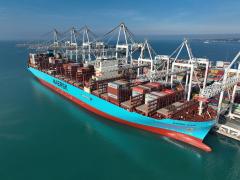
Further consolidation in the shipping industry is inevitable as the lethal mix of excess capacity in a globally depressed market, particularly on the eastwest trades, combined with increasing operational costs contributes to dismal financial performance by large and small shipping lines. It’s the only route to providing competitive services and achieving economies of scale, newly appointed Safmarine CEO Grant Daly told FTW from Antwerp last week. He endorsed the comments made by Maersk Line’s new container shipping head Soren Skou who told Lloyd’s List that the container industry was in need of a further shake-out, with some smaller players best absorbed by bigger lines. He said that more tonnage needed to be removed from the container trades through any number of means, including greater corporate concentration and more ship demolition. DAL Agency SA MD Ron Frick said that following the announcement last year of Maersk Line’s fixed daily service on the Asia-Europe route, it was not unexpected that the immediate competitors in the trade would respond in one form or another. “The recently announced cooperation between the next tier carriers is a demonstration of this – putting their eggs in one basket and creating similar economies of scale,” he said. “With fuel consumption running at around 60% of input costs, carriers need to achieve economies of scale – which is why we’re seeing ever-bigger ships being introduced on the east-west axis on the Far East route.” The shipping industry saw record deliveries of new tonnage in 2011 with significantly more tonnage still to come until 2014, including Maersk’s 18 000- TEU leviathans.as well as other ULCS (ultra large container ships) for other owners. “Older tonnage is not being scrapped at the same pace as the introduction of the new vessels, contributing to the excess capacity available” said Frick Adding to this conundrum is the trade imbalance on eastwest routes, with statistics released recently by Untag demonstrating the point. In 2010, 13.476m TEUs were moved on the Asia- Europe route while just 5.632m TEUs were carried in an west-east direction. This container imbalance pushes up operating costs further. “Shipping will clearly be a challenge in the year ahead – and inevitably there will be some casualties as the financiers of these vessels become increasingly more risk-averse and seek to call in loans.”
‘Expect further consolidation’
Comments | 0
© Now Media. This content is protected by copyright and may not be adapted or republished. If you would like to discuss cooperation opportunities, please contact: editor@freightnews.co.za.