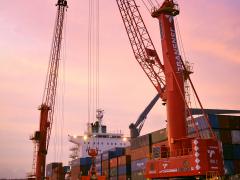
The EU import control system (EUICS) for advanced cargo declarations – with entry summary (ENS) declarations having to be submitted by ocean carriers 24 hours in advance of a vessel’s departure – has settled in and been operating smoothly in its first 15 months of use, according to two shipping line executives. For other modes, the 24-hour period falls away, and is replaced with a specified period prior to the flight or a vehicle’s arrival at the airport or port of first landing. Contrary to fears at its introduction about noncompliant shippers, FTW was told that SA exporters connected into the system reasonably promptly, and few of the consequences of late involvement have come to light. But, as Iain McIntosh, regional sales manager of MOL said, a lot of SA shippers were used to doing it for the US route, and the six-month grace period for the EU system seemed to give most adequate notice. A few faced challenges at the beginning, he added, but soon adjusted to the new system. “Certain of these challenges came to light when ships were delayed, or boxes were late,” McIntosh told FTW. “It required some work to enter things in properly in these cases, but things soon settled down.” Ron Frick, MD of DAL Agency, noted a couple of hiccups at the start of the EUICS regime. “I don’t think that European customs authorities were ready for the extra volume of work,” he said. “But this was all sorted out pretty quickly. “Our SA fruit exporters also had to get all their ducks in a row, with the packing houses getting used to the system. But we had no complaints in the end.” The warning flags that were raised by some members of the SA freight industry about the possibility of numbers of “do not load” signals being received on exports from this country were also soon lowered. Carriers receive three message types from EU customs. The first is a green light which means all documentation is up to speed, and cargo can be loaded. The second calls for inspection at the first port of call, while the third message is that “do not load” instruction, which flags suspicious cargo. Such an instruction has serious implications for the lines in terms of deadfreight – and deadfreight penalties would have seen carriers severely compromised. “But,” McIntosh said, “I’m not aware of any do not loads. SA is unlikely to face such an instruction, as it is relatively low-risk – especially with the main things we export to Europe, like automotive products and fruit.” Frick agreed. “The type of products we load out of Africa, like fruit, is not high risk. It’s only in countries like China, where there are lots of high-tech exports, that ‘do not loads’ are likely to appear.” Both were also adamant that the EUICS was designed for the right reasons and wasn’t an issue for honest traders. And that most customers they dealt with were legitimate – particularly on a mature trade like the Europe route. CAPTION SA exporters connected into the system reasonably promptly.
EU advance notification system beds down smoothly
Comments | 0
© Now Media. This content is protected by copyright and may not be adapted or republished. If you would like to discuss cooperation opportunities, please contact: editor@freightnews.co.za.