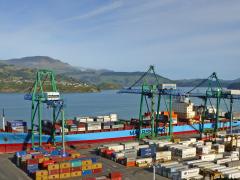
High-level government
discussions are under
way aimed at lowering
port charges to improve
South Africa’s export
competitiveness, especially
in light of an ongoing slump
in commodity prices.
“The South African
economy,
like many
of its global
counterparts,
has been
hard hit by
declining
commodity
prices and we
are looking
at ways to
minimise the
impact of this
on our export
industry,”
trade and
industry minister, Dr Rob
Davies, told FTW last week.
He said that South
Africa’s logistics industry
was “highly competitive”
on a global scale but added
that high port charges,
particularly for export
commodities, were “a
challenge”. According
to Davies, this is being
addressed by government
through its Operation
Phakisa strategy.
Other ways in which
SA could mitigate the
increasingly low commodity
prices, Davies pointed out,
was to diversify its export
offering and to create more
value-added exports. He
commented that South
Africa had seen “important
progress” with regard to
industrialisation and export
beneficiation under the
government’s Industrial
Policy Action Plan (Ipap).
“We’ve made great
strides in the automotive,
clothing and textiles,
and agro-processing
sectors in particular,”
said Davies, dismissing
suggestions that the
country’s manufacturing
was dying a slow death.
“We have challenges, we’ve
acknowledged that we as
government
and industry
have to step
up our game,
but we are
getting there
and the
potential is
enormous,”
he said.
Davies
said that
the dti had
identified
four key focus
areas with
regard to industrialisation
in South Africa. “Firstly, we
need to intensify our efforts
to boost infrastructure
in the country and the
southern African region.
Efficient and sustainable
infrastructure is crucial to
supporting the country’s
industrialisation efforts.”
Secondly, according
to the minister, mineral
beneficiation is essential
to overcoming the
challenge of a decline
in the pricing of raw
commodities. “We have an
abundance of raw metals
and there is an increasing
global demand for valueadded
steel and iron
products for example,”
Davies pointed out.
Furthermore,
manufacturing needs to
be innovation-driven and
the industrialisation plan
needs to be integrated
with the rest of the
continent. “We need a
regional value chain that
is aligned and integrated
with the entire Southern
African Development
Community’s (SADC)
industrialisation strategy,”
said Davies.
“We are stronger if we
combine our resources and
consolidate our efforts to
advance manufacturing in
the region,” he added.
Davies emphasised the
need for government and
the private sector to play
an active role in getting
small and medium (SME)
manufacturers “exportready”,
noting that the dti
was running an export
development programme
that would see businesses
receive their “Export
Passport” once they were
ready to sell their products
on to regional and
international markets.
Davies explained
that this development
programme included
sponsorship to attend
trade missions,
mentorship by established
businesses, as well as
training to help exporters
comply with all the
international trade regulations.
INSERT & CAPTION
We are looking at
ways to minimise the
impact of declining
commodity prices on
our export industry.
– Rob Davies
Dti takes aim at high port charges
Comments | 0
© Now Media. This content is protected by copyright and may not be adapted or republished. If you would like to discuss cooperation opportunities, please contact: editor@freightnews.co.za.