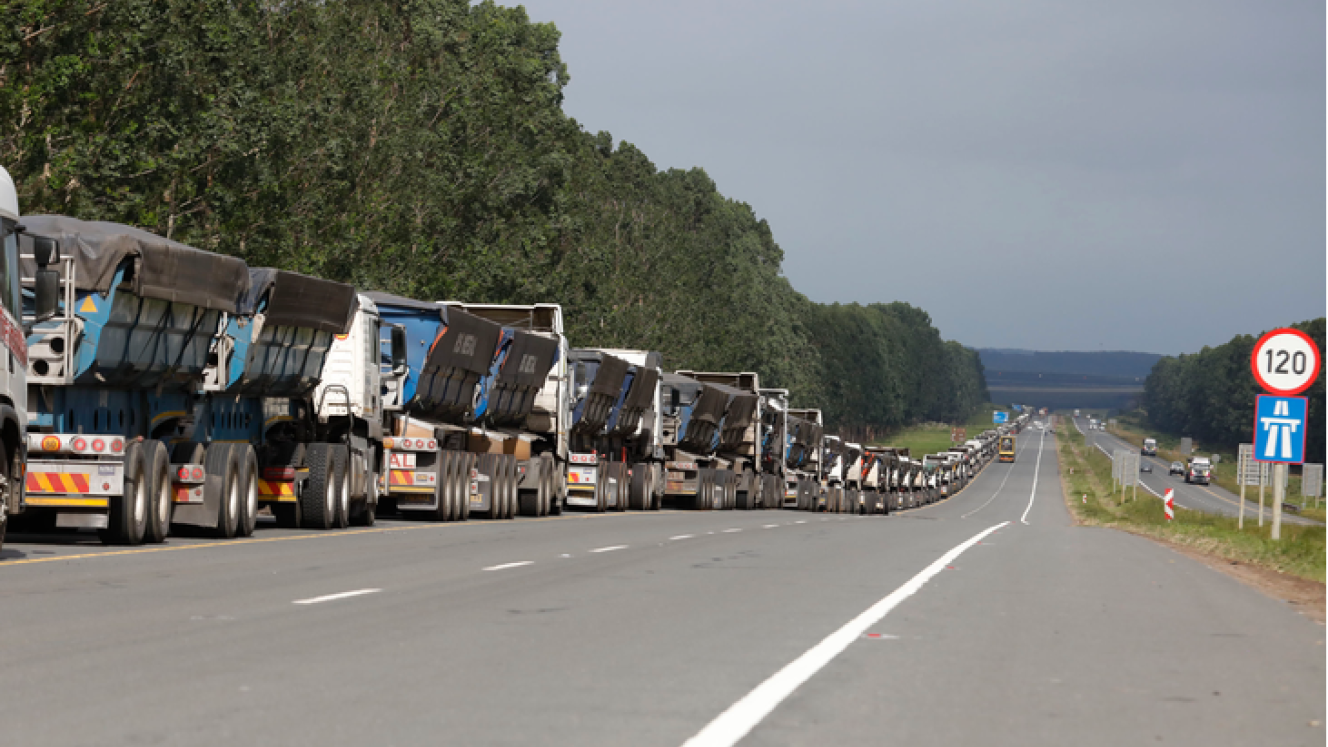
Banning trucks with a gross
vehicle mass (GVM) exceeding
9 000kg during peak hours
remains government’s best
solution to improving road
safety, according to Chris
Hlabisa, deputy director
general: road transport at the
Department of Transport.
Speaking during a panel
discussion at the annual Road
Freight Association (RFA)
conference recently, he said
they were not impervious
to the impact this would
have on the trucking
industry – or the cost of
freight in the country
– but pushing rands
and cents at the
expense of people
was not an option for
government.
“We recognise
and
acknowlede this ban will have
an impact on logistics and the
supply chain and the value
chain, but we still believe
when it comes to road safety
the truck ban is the way to
go – and we want to see these
restrictions happening,” he
said.
Kevin Kamoran, national
transport manager at Nestle,
said the ban would impact
heavily on the manufacturer’s
operations – not only
affecting customer deliveries
but requiring a fine
balancing of stock
across the country.
“Our customers
would have to
be approached
to hold
larger stock
themselves.
That in itself
will already have
a knock-on
effect
– meaning an increase in price
– while the restriction of travel
times on trucks will force us
to put additional vehicles on
the road as we will still have to
meet current demand but at a
lower capacity,” said Kamoran.
“A very real concern that we
have with this proposed ban
is the security
aspect of it.
Ours is a highrisk
product.
This ban will
make us very
susceptible
to theft and
hijacking.”
Abdool
Kader Tayob,
CEO of Bakers
SA, said this
ban would
require a
complete
re-think of South Africa’s
logistics operations and it
would come at a considerable
cost.
Hlabisa, however,
maintained that most truck
accidents happened during
these peak times resulting not
only in the loss of life but major
damage to road infrastructure
– a cost covered by the state
and not the road freight
industry.
John Motsatsing, a director
at the DoT, emphasised that
they were not ignoring the RFA
and truck operators’ voices.
“This legislation has not been
implemented yet. It is still open
for discussion,”
he said. “The
bottom line
is that fatal
crashes have to
be addressed
in this country.
We have to
reduce the
number of
accidents on
our roads.”
He and
Hlabisa
concurred
that while a
ban would have some negative
consequences, government had
no choice but to state upfront
why they were coming up with
extreme measures such as the
truck ban.
• The DoT's proposed ban
would be enforced from
06:00-09:00 and 17:00-
20:00 daily.
Pushing rands
and cents at the
expense of people
is not an option for
government.
– Chris Hlabisa