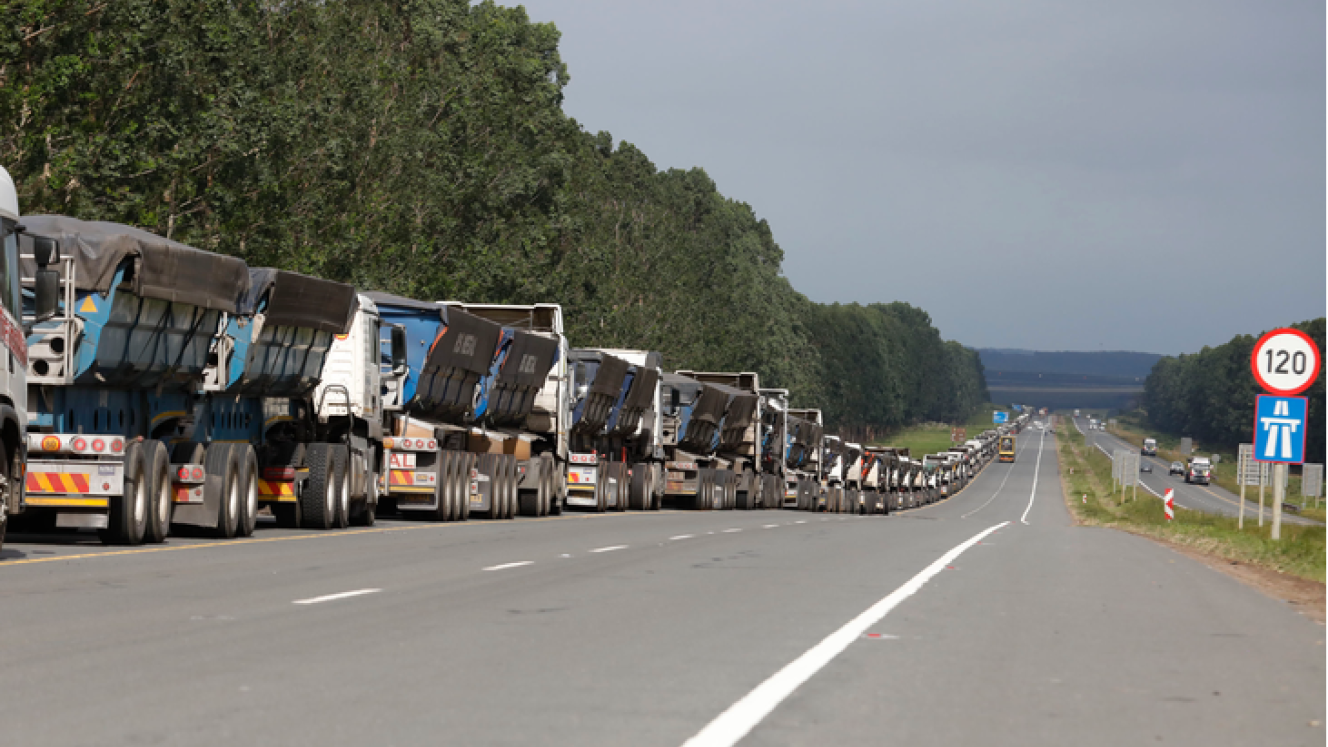
The big players in the SA mineral export league are coal, manganese ore and iron ore, and all suffer from a similar logistical complaint. They are all mined a long way away from seaport gateways. This, according to Iain McIntosh, trade and marketing director of Mitsui OSK Line (MOL), has given each of them landside and maritime puzzles to play with, if they wish to remain competitive in an extremely price-sensitive global marketplace. SA steam coal exports, unfortunately, suffer from a weak link in the landside leg of the supply chain from the inland mines to the coast. Though McIntosh described the main export gateway of the Richards Bay Coal Terminal (RBCT) as a very efficient player, it is not being allowed to be the star it could be. In spite of the global seaborne coal trade increasing from 510-million tonnes per annum in 2005 to an estimated 679-mtpa in 2010 (a 33% increase), SA exports have just not kept pace with this growth. Indeed, McIntosh added, it has in fact registered a net decline of 7-mtpa since 2005. This in spite of RBCT design capacity moving from 76-mtpa in 2009 to 91-mtpa in early 2010 with its phase V completion. “Much of this failure to deliver greater export throughput,” he told FTW, “is due to the Transnet Freight Rail (TFR) coal line which has seen declining performance in recent years. “It has guaranteed to rail 65-mtpa (with an ‘aspiration’ to reach 68-mtpa) in 2010. But the medium-term aim to reach 81-mtpa is unlikely before 2013-2014 – so there is still some way to go.” It’s somewhat better news on the manganese ore front – although it still has to travel over 1 000-kilometres from its source to the coastal seaport outlets. And SA is one of only a few suppliers of this valuable ore – boasting some 80% of global reserves, and well ahead of the other important manganese deposits in Ukraine, Australia, India, China, Gabon and Brazil. “Demand over the period 2010-2015 looks likely to provide significant volume growth but there are challenges,” McIntosh said. “It comes from a considerable distance from the ports and requires a good supply chain to port to keep down free on board (FOB) costs.” It is mined in the north-west of the country in the Kalahari Manganese Field (KMF) and the ore is despatched by train from Hotazel – either through Port Elizabeth or Durban – with some also moving by road into Johannesburg.” Volumes are set to reach over 5-mt in 2010 after a weaker 2009 due to lower demand. “Whilst Durban moves around one million tonnes, and quite a sizeable volume is containerised (approximately 15%),” McIntosh said, “the main gateway for bulk exports remains through the Port Elizabeth manganese bulk terminal which is the closest to the mining area in distance (about 1 100-km).” As the inadequacy of the coal line proves, the essential driver for available tonnage for exports is a good rail system. The TFR rail network provides capacity of 13 100-t per day – which, in practice, translates to 4.6-mt per annum. “The PE port handled 3.2-mt of bulk ore during 2009 and is expected to exceed 3.5-mt in 2010,” McIntosh said, “so there is room for further growth in port volume given the rail capacity available.” While capacity from the mines through all channels is currently restricted to around 6-7-mtpa maximum, McIntosh said that the potential annual demand from the mines in the shorter-term is more in the region of 14-mtpa. “A number of developments are under way to realise this potential,” he added. Transnet is currently casting an eye on the newly-opened port of Ngqura (27-km from PE) with its 14-metre draft as an alternative bulk loading outlet. Meantime, the SA supply of iron ore comes largely from the Sishen field in the Northern Cape – and is all exported via the Orex rail line (861-kms) through the bulk port of Saldanha. The distance the ore travels is 2-3 times longer than major competitors in Brazil and Australia – and gives them a competitive edge in transport costs. However, Transnet has embarked on a major upgrade programme to improve handling capacity and reduce transport costs. “The project also includes an upgrade of the rail line – which is designed to increase Saldanha’s original capacity of 28-mtpa to 60-mtpa,” McIntosh said.
Distance from ports poses logistical puzzle for coal and ore
Comments | 0
© Now Media. This content is protected by copyright and may not be adapted or republished. If you would like to discuss cooperation opportunities, please contact: editor@freightnews.co.za.