Transnet’s white-hot
enthusiasm for the Durban digout
port (DOP) has faded to a
mere glow.
Until not that long ago,
Transnet executives were
excitedly telling the press
that the construction of the
project’s first four-berth phase
should begin next year, with
commissioning proposed for
2020. What they all envisaged
was the creation, in four phases,
of Africa’s largest deep-water
container terminal, capable
of handling 9.6 million TEUs
across 16 berths by 2037, and
incorporating an automotive
terminal and a liquid-bulk
handling facility by 2050.
Even as recently as May this
year, Mark Gregg-Macdonald,
Transnet group executive for
planning and sustainability,
told FTW that the current view
was still that the first phase
should be operational by 2025.
But times and economic
conditions have changed, and
this dating schedule has in turn
been cast aside.
As Richard Vallihu, CE
of Transnet National Ports
Authority (TNPA), said at last
week’s TNPA business-tobusiness
(B2B) breakfast/golf
day, they had “shifted out DOP
a bit”.
“We’re not saying it’s not
going ahead, but we’re putting
it off for two or three years,” he
added.
But he and the rest of his
team largely avoided any
further mention of the DOP –
even ducking at question time a
query from an anxious member
of the freight industry who
expressed urgent concern about
the industry’s future planning
for facilities without a firm time
schedule.
The only hint of possible
timing was made by Durban
port manager, Moshe Motlohi,
who said the Durban port
would see 15% container
capacity growth by 2022/23.
This was due to the deepening/
lengthening of Pier 2 and
the Salisbury Island infill
on Pier 1, which he declared
both now had the go-ahead.
This included an agreement
with the City of Durban and
the provincial department
of environmental affairs on
the environmental impact of
dredging deeper approach
channels for both projects, and
allowed TNPA to extend this
extra depth 50 metres into the
current sand bank.
And the infill is the big
player in this extra capacity
for the old port, according to
Motlohi. It would create an
additional 1.8-million-TEUsper-
annum container terminal,
with a current completion date
of 2021. This, he added, would
create 1 288m of productive
quay length, allowing the
berthing of fully laden vessels
of 9 200-TEU capacity with a
draught of 14.5m.
“This would be enough until
2025, if not 2030,” Motlohi
added.
Another similar attitudinal
change was adopted in relation
to plans for the Cato Ridge
dry port. When asked during
question time for clarification
about the development
schedule for this project, the
TNPA manager appointed to
answer this anxious questioner
did little more than repeat
the basic intention behind the
concept. No dates, no times,
nothing.
INSERT & CAPTION
Salisbury Island infill
is the big player in
this extra capacity
for the old port.
– Moshe Motlohi
CAPTION
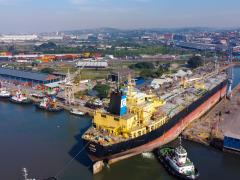
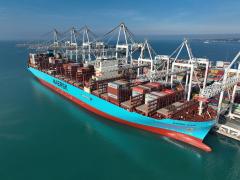
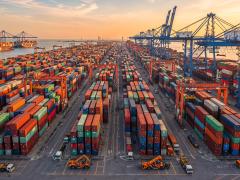
The Port of Durban will see 15% container capacity growth by 2022/23. Photo: Shannon Van Zyl
Dig-out port moves down the priority list
Comments | 0
© Now Media. This content is protected by copyright and may not be adapted or republished. If you would like to discuss cooperation opportunities, please contact: editor@freightnews.co.za.