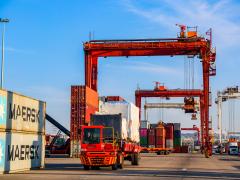
Like it or not, straddle carriers will soon become an extinct ‘species’ in Cape Town Container Terminal, and for sound reasons too, argues Transnet Port Terminals. As it currently stands, seven Cape Town straddles are non-operational, about to be shipped to Durban, leaving Cape Town Container Terminal 14 and MPT eight straddles respectively. Come the end of the year, Cape Town straddle numbers will decrease further to 12, and even further to four by the end of 2011. Akash Maharaj, TPT’s Durban-based national capacity and projects manager, says: “The primary benefit of the RTG over the straddle carrier system is about increasing terminal capacity (higher container stacks), especially in cases where container slots are constrained. “The challenge in the straddle-RTG journey is really about all parties giving the system the natural lead time for the change to fully take effect. It requires equipment operators to be able to adapt to the new technology and feel confident and comfortable with it.” Maharaj points out that Transnet’s contested environmental impact assessment concerning seaward expansion necessitated the switch to RTGs to meet terminal capacity provisioning objectives in line with future demand forecasts. He suggests the doubling of terminal capacity to 1.4 million teus would “not be possible with the continued use of the dated straddle carrier system. “If South Africa and the port of Cape Town user community in particular cannot appreciate the need for change and believe that straddle carriers are our saviour in the future, that future would certainly end at Cape Town when the terminal demand reaches a ruling straddle carrier limitation of 750 000TEUs per annum.”
CT to phase out straddles
Comments | 0
© Now Media. This content is protected by copyright and may not be adapted or republished. If you would like to discuss cooperation opportunities, please contact: editor@freightnews.co.za.