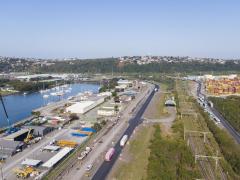
Ray Smuts IF THE current congestion in the Port of Cape Town deteriorates further, a congestion surcharge could well be imposed. That's the word from Albert Schuitmaker, executive director of the Cape Regional Chamber of Commerce and Industry and sole spokesman for the port congestion committee. On whether the surcharge might equal that originally proposed for Durban Ð USD$75 per teu Ð Schuitmaker says it is possible. "Don't discount a surcharge, it's definitely on the radar screen." At the heart of the delays is said to be a lack of stacking space, but Schuitmaker remains unconvinced. "My concern at this stage is that the number of containers in and out of the port on the land side seems to be remaining static at around 700 a day. That is the same figure we had in 1995 so it is certainly not good enough. "If we want to clean out the stacks in the port we have to start moving containers at a rate of about 1 100 a day and that has to be done by the transport companies of which there are now up to 2 000 since initiation of the port's open gates policy." One of the problems identified by the congestion committee is that many cargo owners are not prepared to work after hours and those who do have apparently not been brought into the system to the extent that a free container flow emanates from their premises at night. "Figures show that literally only a few containers move in and out of the port between midnight and 6 a.m. Ð the ideal time for such an operation. Those transport companies we have spoken to are willing to run at night so cargo owners need to be made aware of this." The way Schuitmaker sees it, much of the problem could be alleviated through more synchronised timing between shippers and transporters. To page 16 From page 1 "We clearly cannot deal with all transport operators but can probably identify the major companies and get to a state of Ôpreferential treatment', so that shipper and transporter are clear exactly when a container shipment is due to arrive. "The problem in the past was that many importers and exporters were quite happy to open up on a Saturday morning knowing containers would arrive, but what so often happened is that the crew would eventually be sent home and then a truck would arrive at 4 p.m." Cape Town's container terminal is still working at around 13 moves per crane hour which is largely due to outdated equipment and Schuitmaker has learnt that some of the gantries have to be serviced every 40 hours. "That's only two working days so they have to stop and that does not do much for a week's productivity." As to possible solutions, he says it is fact that all major ports around the world have standing orders for replacement equipment. The Mother City's container terminal moved 52 000 containers for each of the months of March and April. Container traffic was up by 24% in the Port of Cape Town last year; even so plans to extend the terminal to more than double the existing capacity of 400 000, 20-foot, containers will take at least two years to come to fruition.
CT hints at congestion surcharge
Comments | 0
© Now Media. This content is protected by copyright and may not be adapted or republished. If you would like to discuss cooperation opportunities, please contact: editor@freightnews.co.za.