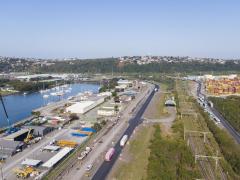
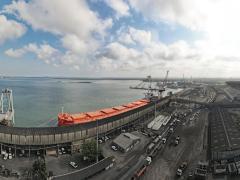
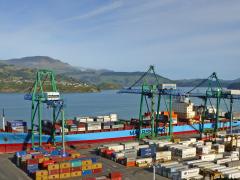
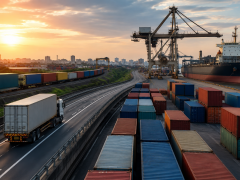
TRANSNET’S DECISION to look for other ways of increasing Cape Town’s container terminal (CTCT) capacity may have a side effect – that of examining other alternatives at Durban. Faced with impassable environmental issues once environment minister threw out the initial proposal to widen CTCT into Table Bay, Transnet has instead opted for making better use of existing land and improved productivity (FTW September 28, 2007). It is this course of action that may now rub off on Durban, where not dissimilar environmental issues are at stake. With an environmental impact assessment (EIA) about to get under way at Durban for a new container basin in the Bayhead area of the harbour, alternate methods of providing urgently needed capacity will also come under scrutiny. One of the issues so far ignored for DCT has been that of converting it to a rubber tyre gantry (RTG) operation and looking for vertical expansion, instead of constantly adding more geography to the equation. Minister Marthinus van Schalkwyk’s Record of Decision for Cape Town has effectively changed all that. Creating an RTG operation at CTCT and ‘maximising existing infrastructure and buildings’ makes this the third South African terminal to introduce what the rest of the world has long known – that an RTG operation provides better utilisation of space than straddle carriers. The other two terminals are Durban’s Pier 1 Container Terminal, due for completion later this year, and Ngqura which has yet to open. An RTG type operation permits the stacking of boxes up to 7-high, compared with 2 or 3- high with straddle carriers. This was something pointed out in the late 1990s by a delegation from Hutchison Port Terminals that said if they were granted a concession to operate DCT the first thing they’d do would be to convert to RTGs. Hutchison made a point of how much space was available at DCT and how badly it was being utilised because of the straddle carrier operation. DCT faces similar obstacles to that of CTCT (and Pier 1) – the stacking area was not constructed for high stacking of boxes and would have to be strengthened but Pier 1 has already shown this can be done. It will be surprising if this does not become an issue with the forthcoming Durban EIA.
Could Durban port expansion follow CT’s example to avoid ‘green’ obstacles?
Comments | 0
© Now Media. This content is protected by copyright and may not be adapted or republished. If you would like to discuss cooperation opportunities, please contact: editor@freightnews.co.za.