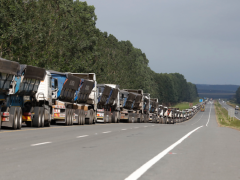
Zambia remains one of the most promising growth points in terms of road freight, says Billy Hoomoedt of Afnet. “That is, of course, on condition that the service is reliable and efficient. We have retained healthy relationships in the country as we believe it has much potential. Hoomoedt said the impact of the recent global economic downturn on the freight industry made it obvious how important the copper industry in Zambia had become, barring the DRC exports. “The copper price has affected our industry tremendously,” he said. “A lot of these effects have been felt by the local consumers and their imports have declined, whether they’re involved directly with the copper industry or as a support unit to this industry.” Hoomoedt says while many people are despondent about the current business environment, with margins remaining very tight for all businesses, the copper price has seen some improvement recently. “This can turn as quickly as it all started and we remain confident that this is not too far in the future. For this reason we have not scaled down on any of our services so remain poised and ready to get back in when it happens. We have also maintained healthy relations with our support infrastructure in Zambia for this purpose.” Having recently purchased a 30-ton forklift to add another dimension to its services, Afnet believes that it is all about continuous improvement. With a history in the freight industry going back to 1996, this freight broking company is still going forward despite the recession. “For us it is all about going back to basics and focusing on reliability and service,” says Hoomoedt. “Zambia is familiar territory to us. We have a good client base and support infrastructure. We are well versed in their documentation requirements, rules and regulations and have veteran hauliers on this run who enable us to maintain our mandate.” In times of crisis, says Hoomoedt, it is all about improving what you do as the market slows down. “We have used this available time as the perfect window to analyse our systems and procedures and improve them so that they are in place when the industry stabilises.”
‘Copper price can turn quickly’
Comments | 0
© Now Media. This content is protected by copyright and may not be adapted or republished. If you would like to discuss cooperation opportunities, please contact: editor@freightnews.co.za.