It’s a shipper’s dream but
a carrier’s nightmare and
there’s consensus that radical
carrier action on the supply
side later this year could be
the only means of survival
for an industry in free fall.
In South Africa it’s the
perfect storm – a decline
in business confidence, a
slow-down in infrastructural
development, a decline in
demand for resources in
Asia, compounded by the
drought that has affected
agricultural production.
“Based on the latest
Transnet statistics, during
the first quarter deep sea
imports declined by 9.1%
compared to last year while
exports declined by 11.5%,”
DAL Agency managing
director Ron Frick told
FTW. “This reflects the state
of the regional southern
African economies. And with
emerging market currencies
having taken a hit against
the dollar and the euro,
import costs have rocketed.
The result has been
a continued downward
pressure on rates in the first
quarter, according to Frick.
“And in addition to these
negative influences comes
the import/export container
imbalance which negatively
affects the operating margins
of the carriers serving the
country.”
While overcapacity is
particularly prevalent in the
east/west trades with freight
rates at almost sub-economic
levels, South Africa is not
immune.
“In almost every corridor
we have seen a significant
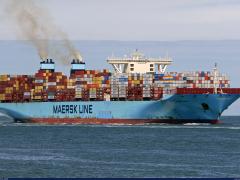
slide in rates,” Maersk Line
southern Africa managing
director Jonathan Horn told
FTW. “The level varies and
it’s a question of supply and
demand on any particular
corridor which drives the
rate impact. If you look at
the trade between South
Africa and the Far East,
which accounts for roughly
half of South Africa’s
total container flows,
there are several similar
characteristics to large
trades like Asia-Europe – a
large number of competitors,
a fair amount of overcapacity
and consequently a lot of rate
volatility.
“While our Safari service
is largely dedicated to the
SA-Far East route, several
players use our ports as a
way port between the Far
East and West Africa and
the Far East and South
America and can inject
or reduce capacity fairly
quickly. This adds to the
capacity dilemma and as a
result rates are quite frankly
unsustainably low at the
moment.”
“It really is a mess,” said
another shipping source.
And the best way to show
it is via the transparent
structure of the Shanghai
Freight Index since January
2014.
“Asia-South Africa was
quite stable at around
US$ 700-800 per TEU for
a number of months. But
by December 2015 it had
collapsed back to US$500
per TEU and then a steady
march down to US$300/
TEU as at today.”
According to our source
most carriers are aiming for
a General Rate Restoration
(GRR) in mid-May. “In
theory it could work as the
supply side has tightened a
little with the Safari service
in the process of reducing
vessel capacity from a mix
of 8 000-9 000 TEUs to
6 500 TEUs in the coming
months, but the demand
side has a question mark as
well so what you see does
not always do what it is
expected to.”
Horn agrees that there is
only one master of freight
rates and that’s the market
– which will determine what
the rate will be.
“However, in order
to continue to make
investments in equipment to
better serve our customers
– be it vessels or containers
or IT infrastructure – you’ve
got to be generating profits,”
said Horn. “We understand
that shipping is a cyclical
business and we’re in it
for the long haul. We’re
also fortunate in that the
Maersk Group has had a
huge focus on driving for
a cost leadership position
before the start of the first
global financial crisis and
has taken many billions
of dollars out in cost over
the past several years.
But ultimately you can’t
continue to take out costs
as the only lever in growing
your business – in order to
build a sustainable business
that meets the needs of our
customers, you have to be
able to lift your top line
alongside constant cost
discipline over time as well.
We need this to happen in
the short term,” said Horn.
All of our commentators
agreed that consolidation
would have to be the order
of the day. “In addition to
consolidation, we will see
more and more asset sharing
– whether through VSAs,
slot purchases or swops
– because that’s another
important lever in making
a material difference to this
capacity overhang,” said
Horn. “The severity of the
global capacity overhang is
borne out by the capacity in
lay-up at the moment – it is
over 8% which is the highest
it’s been for a long time.”
Few will disagree that it’s
as challenging as it gets.

Carriers speak out on ‘unsustainable’ rates
Comments | 0
© Now Media. This content is protected by copyright and may not be adapted or republished. If you would like to discuss cooperation opportunities, please contact: editor@freightnews.co.za.