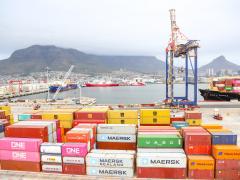
No major players expected to enter the trade ALAN PEAT THE SEA trade between the Far East and SA is still definitely not a buyer’s market, with volumes still booming and ships running full – and several of the main shipping lines content with the rates situation. “Trade volumes are very buoyant,” was how Glen Delve, operations director of Mediterranean Shipping Company (MSC) put it. “So there’s upward pressure on freight rates because of capacity restraints – particularly on the incoming leg. “Also, the outbound rates are holding firm.” It’s been a good year for the shipping lines, according to a ship’s agency executive involved in the Far East sea trade. “We’re already going into our second general rates increase (GRI) of the year this month (September),” he said, “and the peak season surcharge is already on the go.” The increases and the surcharge are all being implemented by most lines on the trade, and generally accepted by shippers because of the acknowledged supply/demand situation, according to Andrew Weiss, operations manager at Mitsui OSK Line (MOL). Our un-named shipping source expressed himself certain that there would be an upward change in tonnage and service during the next year. “As long as the R/US$ exchange rate remains favourable,” he said, “the demand will be there. Shippers would certainly like to see a weakening in the rand to improve the import/export balance in favour of exports – but that’s not likely any time soon.” Weiss agreed there would definitely be more space available in the next year. “New partnerships and increases in vessel sizes can be speculated,” he told FTW. “But they are only stories at the moment.” One thing is sure, according to Delve. “I can’t see any big lines coming into the trade adding a real big chunk of extra capacity.” “We’re continually evaluating the situation, and have already put on more tonnage – matching the vessel availability to the market demand.” The premium size of vessel on the Far East-SA run at the moment, he added, is about 3 000 twenty-foot equivalent unit (TEU) capacity. And that he expected to remain. “There are still a lot of newbuilds coming off the stocks,” he said, “but all the really big tonnage is going on to the main global trades.” Delve, whose line serves the whole Far East area, is looking at direct connections with the likes of all the main Chinese ports, Korea, Indonesia, Japan and Singapore. “Virtually the whole of Asia,” he said. “And it all continues to be an area of growth – and will remain so for the next year.” Weiss suggested that China had been one of MOL’s main areas of growth, and although not a big market yet, Vietnam is also showing good potential. It certainly looks as though importers and exporters are going to have to continue to dig their hands deep into their pockets to cover the seafreight rates on the Far East trade – at least for the near future.
Buoyant volumes keep seafreight rates firm
Comments | 0
© Now Media. This content is protected by copyright and may not be adapted or republished. If you would like to discuss cooperation opportunities, please contact: editor@freightnews.co.za.