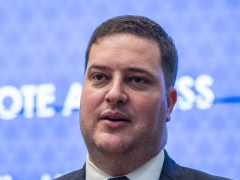
The International Bunker Industry Association (Ibia) has calmed industry concerns over the impact of the 2020 sulphur cap. Speaking in Cape Town recently, Ibia CEO Justin Murphy said several myths were doing the rounds – not only causing confusion but also creating anxiety over the future of the bunkering industry come 2020.
While there was no doubt that bunkering would undergo radical change in the coming years Murphy said there was no need for panic. He dismissed industry fear-mongers who predict a turbulent transition to the 2020 sulphur cap, if it happens at all.
“That is possibly the biggest myth we are dealing with – that the global sulphur cap implementation date will be deferred beyond January 1, 2020,” said Murphy. “The fact is it won’t. Many may be hoping for that, but there are far too many legislative reasons for that to happen.”
Another myth, said Murphy, was that ship owners had been rushed into the sulphur cap and had no time to prepare, while they also could not afford it. The International Maritime Organisation (IMO) decision to implement a 0.50% sulphur cap on marine fuel from 2020 is arguably one of the industry’s defining moments and has been much debated in the past couple of years, according to Murphy.
The current global sulphur cap is 3.5%, while the average sulphur content of most of the current heavy fuel oil (HFO) bunkers is around 2.7%. Only vessels that equip themselves with exhaust gas cleaning systems known as scrubbers will be able to continue burning these same bunkers from 2020 or they will have to move to burning a compliant bunkering fuel.
“This has not come out of nowhere,” said Murphy. “The industry has been working on the sulphur cap for at least ten years giving ample time for us to prepare for what is coming.” He said in terms of affordability, Greek ship owners in particular had been extremely vocal about their inability to afford the change. Greeks remained the dominant force in global shipping, owning a fleet worth approximately $100 billion, followed by China’s fleet at $84 billion and Japan at $80 billion.
Commenting on the availability of compliant bunker fuel, Murphy said he did not expect it to be readily available prior to 2020 but this was due to economic rather than technical reasons and most oil companies were already in a position to deliver sulphur capped fuel.
“You can already buy 0.50% sulphur marine fuel,” he said. “It has to be seen in perspective. If they were to deliver capacity today to meet the entire global demand they would not be able to but refiners and suppliers respond to market signals and they will prepare to sell it in larger quantities come 2020.”
But, he said, that did not mean there would not be some supply issues initially. It was however not expected to be the massive problem that was being reported. According to Murphy, one of the more pressing questions was how the IMO was planning to enforce the new regulation.
“We believe that most of the industry will do the right thing although enforcement will be fairly inconsistent at the start. Much work is being done at the moment with regard to compliance and enforcement and to address some of the concerns.”
CAPTION
Tahra Sergeant, Ibia regional manager: Africa, Justin Murphy, IBIA CEO, and Patrick Holloway, Ibia board member and Webber Wentzel partner.