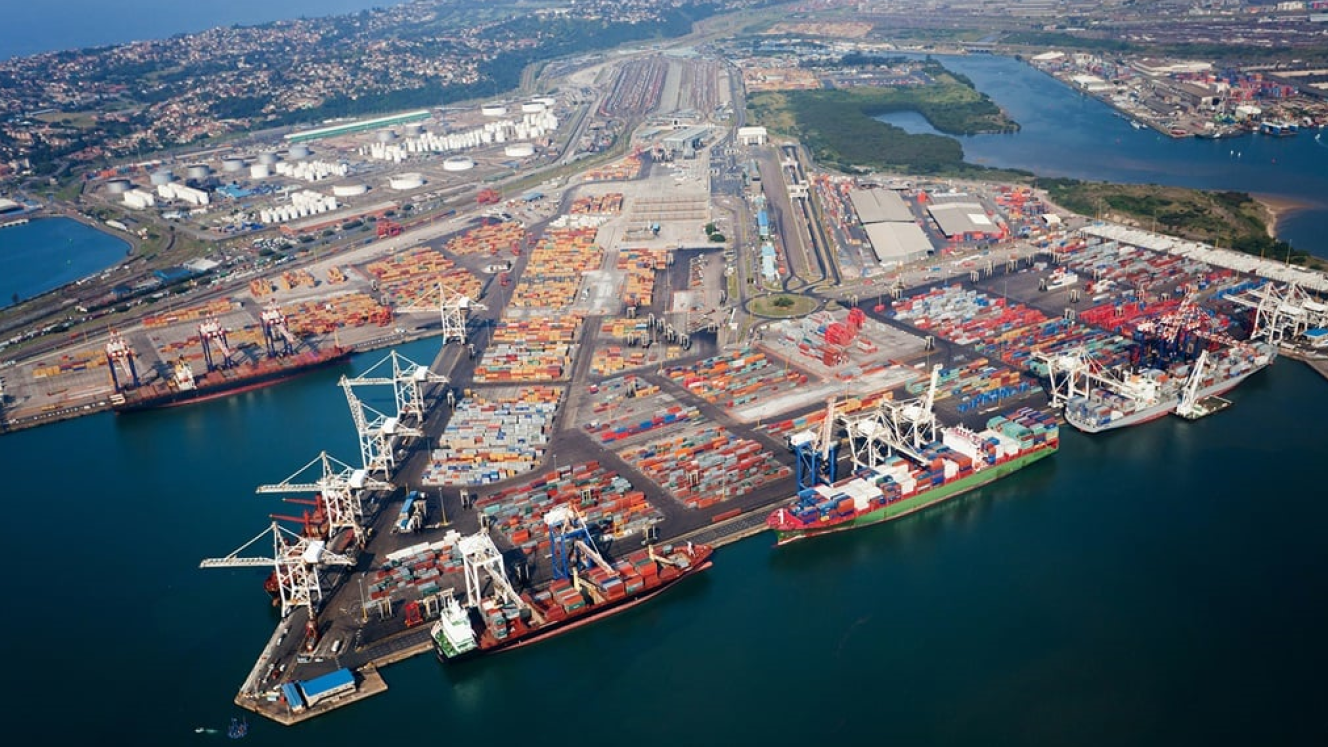
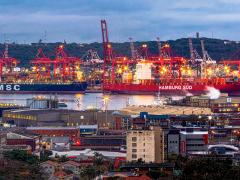
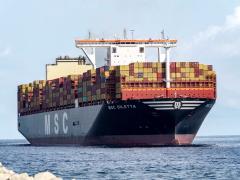
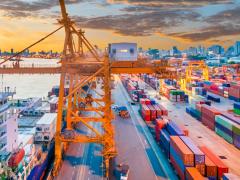
The oft-heard words of port congestion are being shouted around the Port of Durban again – this time waterside, as shipowners/ operators bleat about worrying berthing delays and vessels having to bypass the port to keep their schedules up to their promised par. And, while shipping lines accept that weather has played its role in the last couple of weeks, they insist that there’s an on-going underlying problem in Transnet’s container terminal operations. Said one shipping line executive: “If it’s not the weather, it’s some other continually repeated excuse. But we’re sick of hearing these when it’s obvious there’s an inherent problem at the root of it all.“ The berthing is a big problem, with one ship, for example, held at anchor in the roads for 10 days, and another for a week. “Also, the stack occupancy is high, and that causes its own problem. Pier 1, for instance, is running at 91%, and productivity is a major worry.” Andrew Thomas, CEO of the Grindrod feeder shipping service, Ocean Africa Container Lines (OACL), agreed with the criticism. “The whole thing is a never-ending problem,” he told FTW. “We have serious port congestion, and it has got worse since the introduction of the Navis port management system. “I agree – productivity is very poor. We need the 30% increase in productivity promised by Transnet Port Terminals (TPT). Until then, port congestion will be the on-going result.” Thomas also stressed that the extra capacity built into the port’s terminal operations just does not exist in real terms. “Therefore, we’ll continue to face congestion until significant extra capacity is put in place.” Iain McIntosh, marketing manager of Mitsui OSK Line (MOL), joined the complainants. “A lot of problems with ships getting berthing, and it’s throwing our schedules out of gear,” he said. McIntosh noted that there were a couple of factors which could help to relieve the problem, like CSAV pulling out of a number of services through SA, and leaving a bit of extra berth space; and extensions to the port’s terminal infrastructure promised by Transnet. “But, right now,” he added, “things are just not good.” Another unhappy shipping line executive was Sam Moffitt, MD of Hamburg Süd, an Australian who was equally unhappy about the Wallabies tragic loss to the Kiwis last Saturday. But, returning his mind to the shipping business, Moffitt said that berth congestion had been a major problem recently. “Our service has had to bypass Durban on two occasions,” he said, “while at times we have also had to limit vessel operations to keep to our schedules.” He also emphasised that port operations were a major cost factor. “And port congestion therefore leads to all sorts of extra costs,” Moffitt added. He also called for a collaborative approach to the current problem. “We and Transnet must get together on any container operation hassles that put shipping lines at risk,” he told FTW. “But, saying that, the berth planning going forward looks better. “We must maintain that if we’re to escape the present troubles.”
Berthing delays cause havoc at Durban Port
Comments | 0
© Now Media. This content is protected by copyright and may not be adapted or republished. If you would like to discuss cooperation opportunities, please contact: editor@freightnews.co.za.