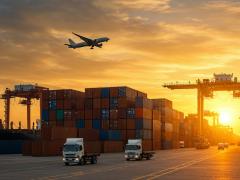
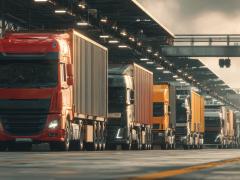
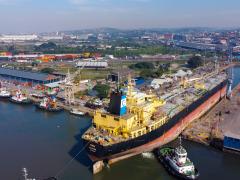
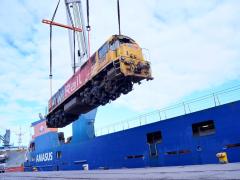
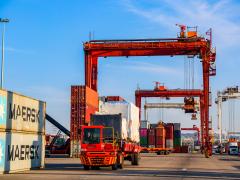
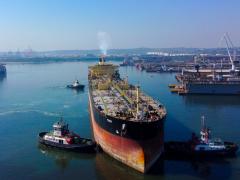
Transnet Port Terminals (TPT) provides world-class cargo handling and logistics services at seven commercial ports along South Africa’s coastline. Representing a broad spectrum of the economy, TPT customers include the shipping industry, vehicle manufacturers, agriculture, timber, the mining industry and exporters of minerals, metals and granite. RICHARDS BAY Richards Bay Terminal, north of Durban, boasts a trading history of 36 years. The terminal’s bulk facility handles 12 core commodities (mainly coal and other minerals) and it has a dedicated woodchip berth. The terminal ranks amongst the most efficient woodchip handling facilities in the world. It has a total of 14 berths and handles cargo via a 40km computercontrolled conveyor belt network. Richards Bay currently handles a total of 18 million tons of cargo annually. However, the total capacity of the terminal is estimated at 21 million tons. DURBAN On the east coast of South Africa, Durban port consists of two terminals, namely Durban Container Terminal (DCT Pier 1 and Pier 2) and Durban Ro-Ro and Maydon Wharf Terminal. DCT is among the busiest terminals in Africa with a combined capacity of 2.8 million twenty foot equivalent units (TEUs). The terminal handles general purpose containers, reefer containers, abnormal containers as well as tanktainers, including import, export and transhipment cargo. Recent investments of R2 billion and R1.4 billion in DCT Pier 1 and DCT Pier 2 respectively mean that the terminal has increased capacity and improved efficiency. Ro-ro automotive, with a capacity for 520 000 fully built units (FBUs), is South Africa’s largest car facility and the best equipped in the southern hemisphere. The agri-bulk facility located at Maydon Wharf handles wheat, maize, animal feed and woodchips. It also features a state-of-the-art 80 000-ton capacity soya-handling facility. EAST LONDON The East London Terminal in the Eastern Cape has the largest bulk grain silo on the South African coastline for free-flowing grains such as maize and wheat. It is able to handle 76 000 tons per annum. It also has a combi facility for breakbulk and containerised cargo (up to 90 000 TEUs), as well as a ro-ro facility for 139 000 fully built units (FBUs) which is NOSCAR rated. It includes sophisticated, multi-level parking bays. NGQURA Ngqura Container Terminal, close to Port Elizabeth, is TPT’s youngest terminal, having opened in October 2009. It has been designed as a world-class transhipment hub, servicing traffic from the East, South America and West African markets. The terminal accommodates super post-panamax vessels with deep-water berths and is pivotal to the Coega Industrial Development Zone which provides full intermodal connectivity. The current capacity is 800 000 TEUs which will be increased to 2.3 million TEUs in time. It is also equipped with 22 rubber tyre gantry (RTG) cranes at present, which will be increased to 52 in phase two. PORT ELIZABETH Port Elizabeth Terminal is a multipurpose terminal consisting of a container facility, a NOSCAR-rated ro-ro facility and a bulk facility divided into breakbulk and mineral bulk. The container capacity is 400 000 TEUs and the ro-ro facility can handle 196 000 fully built units (FBUs), with 5 000 parking bays as well as car wash facilities. A specialised manganese facility was recently upgraded to enhance capacity and improve environmental performance, with a mineral bulk capacity of 5.5 million tons per year. CAPE TOWN Cape Town Terminal is divided into two facilities including containers and an agri-bulk facility. A large commodity mix exists, but the terminal focuses on containers, general cargo, vehicles and textiles, as well as meat, fish, fruit, barley, wheat, maize, soya, oats and fertiliser. After Durban Container Terminal, the Cape Town Container Terminal (CTCT) is the second largest container terminal in South Africa. A R5.4-billion upgrade is well under way for the terminal and will increase capacity to 1.4 million TEUs on completion. It includes a new quay wall, increasing the number of berths from two to four, deepening berths to 15.5m and extending them by 10 metres, increasing the number of reefer points to 3 783 and buying 28 rubber tyre gantry (RTG) cranes. A major commodity of the CTCT is fruit exports, which constitute 17% of the total throughput of approximately 600 000 TEUs per annum. These include exotic fruit, citrus fruit, deciduous fruit, sub-tropical fruit, vegetables, flora, grain and oil seeds. The agri-bulk capacity is 400 000 tons, which is double the breakbulk capacity at 200 000 tons per annum. SALDANHA Bulk Terminal Saldanha (BTS), situated about 140km northwest of Cape Town, handles bulk commodities including breakbulk such as steel rods and coils as well as bulk of mostly minerals. The construction of Saldanha harbour began in 1973 and the first iron ore consignment was exported in September 1976. It is home to South Africa’s only dedicated iron ore terminal, and the largest iron ore export facility in Africa. The capacity for bulk such as iron ore is 58 million tons per year, whereas the break-bulk such as steel products, is 3 million tons. An investment of close to R10 billion for the Sishen-Saldanha rail-to-port iron ore channel will increase export capacity to 60 million tons. In this water-scarce area of the Western Cape, TPT has built a reverse osmosis plant that desalinates seawater which is then used in the sprinklers that spray water onto the stockpiles to suppress dust.
ADVERTORIAL
Comments | 0
© Now Media. This content is protected by copyright and may not be adapted or republished. If you would like to discuss cooperation opportunities, please contact: editor@freightnews.co.za.