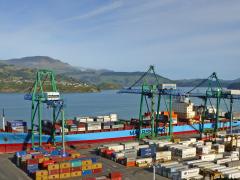
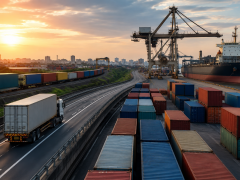
The first of three national dry ports established by the port of Walvis Bay for neighbouring countries starts operating this month. Developed and financed as a public private partnership by African Union Financial Services, the Zambian dry port is being built in two phases – the first being a 10 000 sqm container park capable of handling 1 200 TEUs at a time, according to Walvis Bay operations manager Roland Naidoo. Work has yet to start on the dry ports for Zimbabwe and Botswana in the port. The Zambian dry port, which is fully secured and bonded, also has 48 reefer plug points to cater for frozen cargo such as chicken, meat and fish bound for Zambia, the Democratic Republic of Congo, and Angola, says Naidoo. “We anticipate that the export of cathodes, manganese ore, copper and the like, mainly from the Zambian Copperbelt, will move through our facility. We have visited Copperbelt mines, and they have shown keen interest in our facility,” he says. The advantages of the dry port are lower handling charges – the container park is less than a kilometre from the main container terminal in the port. African Union Cargo, the operating company, which is a 100% subsidiary of Africa Union Financial Services (AUFS), will provide a “one-stop” service, including storage, clearing and forwarding. Naidoo had his own clearing and forwarding agency in Durban, and was approached by AUFS – one of his clients – to establish the Walvis Bay dry port. Another plus for the dry port is that, in addition to the port security, the container park is enclosed by palisade fencing, with the addition of an internal electric fence and CCTV camera coverage.
Zambian dry port moves into action
Comments | 0
© Now Media. This content is protected by copyright and may not be adapted or republished. If you would like to discuss cooperation opportunities, please contact: editor@freightnews.co.za.