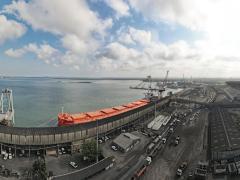
As manufacturers examine ways of minimising environmental risks in their outbound supply chains, they are demanding more environmental accountability and transparency from their forwarders and logistics suppliers. Executives at Wallenius Wilhelmsen Logistics see this as an opportunity to showcase the economic value of strong environmental practices. According to Melanie Moore, WWL global head of environmental matters, the future will require shippers and operators to think differently about energy and land use. Not only in terms of supply and demand but also in relation to demands for a greener and leaner supply chain and the need to comply with national and international environmental legislation. “To drive progress towards sustainability both on sea and on land, WWL has come up with two state-of-the-art “green” concepts – the E/S Orcelle and the Castor Green Terminal,” she said. “Combining proven and unproven technologies, the concept ship and terminal provide an innovative vision of a more environmentally sound future which is a winwin situation for society, the environment and industry.” WWL’s futuristic stateof- the-art environmentally friendly concept, the Castor Green Terminal & Processing Centre, symbolises its long-term vision – a zeroemissions terminal and processing centre which runs on renewable energy, recycles all its waste and efficiently loads and discharges all types of roro cargo, minimising the risk to the environment. “We believe that most of the technologies under consideration for the Castor concept are realistic from a technical point of view but many of them are not yet economically feasible,” said Moore. “Nevertheless, with the current speed of technological development, we are confident that a terminal of this kind could be a reality by 2020.” The E/S Orcelle is WWL’s zero-emission roro concept vessel, which runs on renewable energy sources like wind, solar and wave power, as well as fuel cell technology. With its optimised cargocarrying capacity design, due to the use of lightweight materials, including aluminium and thermoplastic composites, the Orcelle could carry around 10 000 cars – about 25% more than today’s carriers. Even though it is highly unlikely that this exact vessel will ever be built, the next generation of vessels will include at least some of the Orcelle’s features in the next fifteen years, said Moore.
WWL unveils ‘technically viable’ zero-emissions terminal
Comments | 0
© Now Media. This content is protected by copyright and may not be adapted or republished. If you would like to discuss cooperation opportunities, please contact: editor@freightnews.co.za.