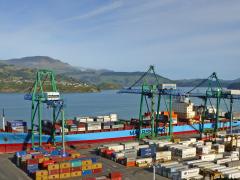
At the Port of Cape Town women are doing it for themselves. It’s the only port operation in South Africa to be headed by women and it’s an achievement of which it is extremely proud. Brenda Magqwaka, recently appointed as the terminal manager (TM) of the Cape Town Container Terminal (CTCT), is responsible for overseeing the overall operations of the terminal, while Christina van Dyk is the TM for the Cape Town Agri RORO Terminal (CTAR). They are both resultsdriven. “I think when women step into positions that have always been dominated by men there is always a slight hesitancy about their capability, but ultimately it is about showing your colleagues, both male and female, results,” said Magqwaka. She and Van Dyk have both notched up years of experience in the field of port logistics and have taken advantage of academic and professional opportunities available from Transnet to get where they are today. “I think women often have to work twice as hard as their male counterparts – especially in the maledominated port operations environment – to prove themselves,” she said. “I don’t necessarily do things the way a man would, but ultimately it is about my ability to manage the terminal successfully.” Van Dyk agrees. “I believe in hard work and ultimately in results. It is about getting the job done.” And they are two of several women making their mark in the port. Norraine Allies is the first female operator of lifting equipment employed at the CTAR and millwright Thandazwa Dyasi has taken on the position of examiner at the terminal. But it is not just in Cape Town where women have excelled. In Durban TPT’s finance departments are headed up by Sharla Pillay who is the company’s chief financial officer (CFO) and also serves on the executive committee. TPT in recent years has embarked on a concerted empowerment training programme in an effort to attract an increasing number of women to the field. Currently it employs over 6 000 people nationally, of which approximately 23% are women. INSERT ‘TPT has embarked on a concerted empowerment training programme to attract women to the field.’
Woman-power rules in CT
Comments | 0
© Now Media. This content is protected by copyright and may not be adapted or republished. If you would like to discuss cooperation opportunities, please contact: editor@freightnews.co.za.