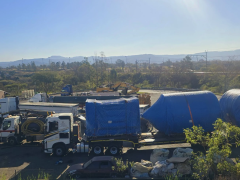
Cecil John Rhodes’s vision of a Cape to Cairo rail link lives on. Wherever FTW meets with industry players in Southern Africa, the talk invariably turns to the need for efficient rail systems. Even owners and managers of trucking companies see the need for rail. Numerous studies have proven that a return to rail will make African exporters more competitive. In their study on sub Saharan Africa’s Rail Freight Transport System: Potential Impact of Densification on Cost, Anneke de Bod and Jan Havenga of the Centre for Supply Chain Management, Department of Logistics Stellenbosch University, argue that a virtuous circle is created when rail moves significant volumes. “Businesses in general should become more competitive and railways can negotiate more profitable rates ie, if transport costs can be reduced by 30%, the railway could charge 15% more and businesses would save 15% on transport costs. Lastly, the investment in infrastructure could, by itself, create induced economic growth.” Rail corridors have been identified and prioritised. Transport Director-General George Mahlalela said some of the milestones already attained under the New Partnership for Africa’s Development (Nepad) Short Term Action Plan included: The acceleration of the Trans Kalahari Corridor between South Africa, Namibia, and Botswana, which is key to the integration of the SADC region; the forming of a “strong relationship” between Mozambican state rail CFM and South Africa’s Transnet Freight Rail with a view to strengthening ties and operations along the Ressano-Garcia corridor route; talks with Lesotho with the long-term goal of establishing a railway line linking Lesotho with the ports of Durban and Port Elizabeth. Nepad is also supporting the concessioning of railways in Kenya, Uganda, Tanzania, Zambia and Swaziland. Speaking to people on the ground, however, a very different picture emerges. First is that concessioning is not a panacea – as Mozambique discovered when an Indian company failed to deliver on the upgrading of the system serving the central provinces. As a result, millions of tons of coal are due to be hauled by road. In Zambia, the government terminated in September the freight and passenger concession with the Railway Systems of Zambia. Finance Minister Alexander Chikwanda, in a statement read on national television, said government had decided to reclaim the concession rights due to the mismanagement of Zambia Railways infrastructure and rolling stock, leading to deterioration of assets and resultant loss to the nation as a whole. The focus on bulk commodities services is also limiting the potential impact of rail. There are concerns in Port Elizabeth that TFR’s plans to upgrade the Northern Cape-Ngqura link to handle manganese exports do not include adding container and vehicle capacity to the Port Elizabeth and Ngqura-Gauteng route. There are similar concerns in northern Mozambique, where a link from Tete through to Nacala is being planned primarily to handle bulk coal. Any benefit to agriculture and manufacturing will largely be lost. There are many similar examples, with both state-run and concessionaires following the money rather than meeting the developmental needs of the region. In Maputo, shippers complain that CFM and TFR are not necessarily cosy bedfellows. Both are driven by the need to make a profit, and TFR is seen to be favouring South African ports at the expense of Maputo and Beira – as well as the cargo owners, whose transport costs are higher. Mines wanting to use Maputo rely on road due to a lack of support infrastructure. Rail bosses can’t be blamed – their brief is to make their operations profitable. It is only when government changes that brief to one of providing cost-effective logistics support to enable manufacturing and agriculture to be globally competitive that the millions of unemployed Africans will start seeing some benefits from the natural wealth, which is currently being exported in raw form. There are many examples of this strategy working – closest to home being the roll-out of rail – across southern Africa sparked by Rhodes’s vision. Africa has the means to revive its rail systems, which can be funded initially through mineral exports. It has the opportunity with fast-growing economies and it has the motive in the need to create jobs and a better future for all its people. The question is whether the elected representatives have the will to make it happen. In the meantime, freight will keep on trucking. INSERT Nepad is supporting the concessioning of railways in Kenya, Uganda, Tanzania, Zambia and Swaziland. CAPTION Africa’s rail system is in sore need of tender loving care – and new investment – as these wagons parked in the port of Beira attest.
Will African rail ever get back on the tracks?
Comments | 0
© Now Media. This content is protected by copyright and may not be adapted or republished. If you would like to discuss cooperation opportunities, please contact: editor@freightnews.co.za.