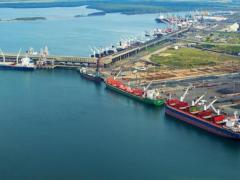
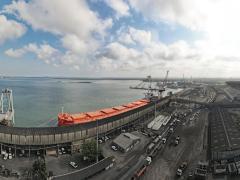
Coega Development Corporation communications manager Raymond Hartle responds to some of the many unanswered questions. Shippers say there was no proper bidding process, that it was non-transparent. The solicitation process has been a transparent one without stipulating the type of investors or investments deemed appropriate. Coega Development Corporation issued an international solicitation for a private partner in the development of the Coega Project (in February 2000). Four bids were received and P&O Nedlloyd/TCI Infrastructure, which showed specific interest in developing a port container terminal and a logistics park in the Industrial Development Zone, emerged the 'preferred' private partner. Their involvement does not preclude any other partnership agreements being reached between the CDC and the private sector. The major shipping lines also say they were never consulted on the development. There has been wide interaction with a range of potential investors in the IDZ as well as with potential users of the port and IDZ infrastructure. P&O Nedlloyd would not have expressed interest unless there was a business opportunity. Their proposal is based on a detailed business plan incorporating feasibility studies. The CDC's assessment of this business opportunity has taken account of a range of factors including sector market conditions, global trends and macro-economic indicators. It is facile to suggest an investment proposal should be canvassed with market rivals specifically. Shippers are not aware that any anchor tenants are yet in place The absence of that infrastructure is a classic 'chicken and egg' situation in that investors will not make an investment decision if they do not have access to, inter alia, serviced land and transportation networks; an infrastructure developer will not make the investments until a tenant is signed up. Now that a programme to roll out the infrastructure is in place the CDC, working with a range of associate agencies, is vigorously pursuing investments in the IDZ. Shippers are concerned about the absence of rail infrastructure, its cost and who will ultimately foot the bill. An inter-modal study has been done which includes all the necessary rail linkages. Transportation costs - whether shipping or railage - have consistently been raised as constituting a disincentive to trade growth. It is not in the interests of the IDZ or South Africa's growth prospects generally for customers to be burdened with the costs of developing world class infrastructure. It is not posible to disclose commercial information such as direct costs at this stage. Shippers say there is no need for a hub port in the Southern Hemisphere as Durban is adequate. The CDC's studies, the commercial proposal by P&O Nedlloyd/ TC1, as well as information gleaned from competitor shipping companies indicate the contrary to be the case. Shippers ask why Coega when Port Elizabeth is still below capacity. The current depth of Port Elizabeth is 10,5 metres and any further substantial dredging would undermine the quay walls. International shipping trends dictate that bigger ships are being built to take account of economies of scale. Ths means that ports around the world have to be deep enough and have the requisite infrastructure to service bigger ships.The Coega port, with its ultimate depth estimated at 23m below chart datum, takes account of these changes in shipping and logistics operations. Shippers ask why work has started while an environmental impact study is till underway Following the public participation process the CDC has submitted applications to the relevant authorities for the rezoning of the core development area and the mining of the Western Coega Kop Quarry. The inclusion of a container terminal in the port design required a reassessment of the environmental impacts and a further study was commissioned. The report will be presented to the public in June. There is no environmental fatal flaw which would mitigate against the project being implemented and Government is satisfied that the project is viable in every respect. What are the current projected costs of the various components? Port infrastructure - breakwater, quays and dredging R1,65 billion. Container terminal investment - estimated at R800 million Construction of the port will commence later this year and continue over three years with the first vessel coming alongside in 2004.
'We were transparent'
Comments | 0
© Now Media. This content is protected by copyright and may not be adapted or republished. If you would like to discuss cooperation opportunities, please contact: editor@freightnews.co.za.