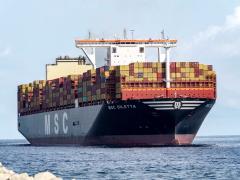
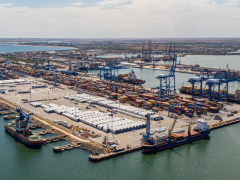
Ray Smuts THE GENERAL improvement in turnabout time notwithstanding, Cape Town's container terminal was not out of the woods last week when it had to contend with delays of 48 hours due to headaches not of its own making. The cause was the arrival under tow last Tuesday of the huge Glas Dowr, a 24l-metre, 56 924 gross ton floating oil production platform. A converted oil tanker, she has come to Cape Town from Rotterdam for a five-month refit to enable her to operate off the South African coast. According to harbour master Eddie Bremner, the vessel has virtually no winches so securing her at A-berth was none too easy. "We were led to believe it would be quite a quick job but it did not work out like that and although it took time, safety is our first priority." Bremner told FTW that because of expectations that the weather would deteriorate, two of the port's three tugs held the Glas Dowr fast for about 12 hours. In addition the Smit Marine tug Wolraad Woltemade was called in to assist. Container terminal manager Ian Bouwer told FTW on Monday that the oil vessel's arrival had left the terminal without service for 48 hours which had created a "knock-on effect". "The average delay is about 24 hours at present and there are five vessels outside (at anchor) but we are starting to bring them in." According to SA Port Operations' vessel working operations report for Cape Town's container terminal, anticipated delays last week were MSC Jessica (27 hours) and MSC Lauren (45 hours) Heemskerck (34 hours) and Sunray Anna (8 hours). The report says space for reefer export containers is still insufficient to cater for high volumes and that reefer exports into the terminal are being managed selectively on a vessel by vessel basis. One of the six cranes is expected to be out of operation for six weeks due to a burnt out computer board but Bouwer does not expect this to hamper operations to any significant degree. Ten haulers are also in for repairs but 38 are in operation and Bouwer makes the point that only 30 are required at any given time.
Unexpected arrival knocks CT back into 'delay mode'
Comments | 0
© Now Media. This content is protected by copyright and may not be adapted or republished. If you would like to discuss cooperation opportunities, please contact: editor@freightnews.co.za.