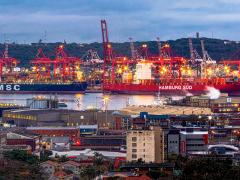
The Transnet National Ports Authority (TNPA) has filed its tariff application with the Ports Regulator for 2012/2013, requesting an average increase of 18.06%. And not only is that the average increase for all cargo categories (bulk, breakbulk, and containerised), but everything – bulk and breakbulk imports and exports, containerised imports and exports for all sizes of boxes, and all the individual industry (cargo) categories. All exactly an18.06% increase. “We understand from sources that the TNPA’s requested increase has caused significant flutters in the industry,” a maritime lawyer told FTW. Meanwhile, according to another maritime legal specialist, Quintus van der Merwe of Shepstone & Wylie, his industry contacts were demanding to know how the TNPA had managed to come up with its figures. “They said that there must be transparency,” he told FTW, “both on how the increases have been calculated, and how they are justified.” Andrew Robinson, the maritime legal eagle at Norton Rose, agreed. “I’ve heard people saying they’re puzzled,” he said. “They were looking for an increase of between 5% and 8%, but here is TNPA looking for 18.06% – over three times the inflation rate. “They have to explain their motivation.” But at least the TNPA has learned something from the past two years, he added. “They are not looking for ridiculously high increases for individual product categories – some as high as 800% last year,” Robinson said. However, Peter Newton, CEO of Cape Town-based Seaboard International Trading, took a considerably less diplomatic attitude to the increases. “TNPA’s 102-page application to the Ports Regulator for an 18.6% across the-board increase not only boggles the mind but is an insult to the intelligence of the private sector at large,” he said. “TNPA must know they’ve no hope of getting the requested increase, and are probably strategising that, by asking for the moon, they’ll probably end up with more than they deserve. “The outrageous application has given rise to widespread condemnation, resentment and grave concern, given the knock-on effects on the economy and the well-being of the country as a whole.” The problem is that the TNPA is the monopolistic controller of all the SA harbours, and exporters and shippers said this lack of competition contributed to high costs. State-owned TNPA charges an average container vessel US$182 151 to dock in Durban, according to the Ports Regulator. That’s more than double a global average of US$86 251 and the highest of 100 top harbours. Productivity at South African ports is also lower than at other major docks, resulting in congestion and delays, according to a study published by the Ports Regulator in September 2010. Cranes at Durban port move an average 23 containers an hour, compared with 94 in Antwerp,” the study said. Several lines have complained of paying firstclass prices for economyclass services. Combined with the rand’s strength and rising labour and energy costs, such charges are limiting profits at exporters including Sappi, the world’s largest maker of glossy paper, rival Mondi and ArcelorMittal SA (ACL), the continent’s biggest steelmaker, Mohamed Kharva, an analyst at Nedbank Group, told BBC News. “It hobbles the economy of South Africa,” Glenn Adriaanse, export services manager at Sappi Trading, added. “These costs all add up and eventually filter down to the bottom line.” “Companies such as Sappi are plagued by higher costs and don’t have the pricing power to pass this on to customers,” Kharva said. “It’s extremely negative for the company. Their profitability starts to diminish and that doesn’t make it a great investment.” Meanwhile, the Ports Regulator is currently looking at the motivation processes and calculation of the tariffs – and also looking at the way TNPA has allocated the prices across all the individual products. “Our job is to ensure there’s appropriate pricing,” CEO Riad Khan told FTW. “Inefficiency in the port system is a brake on the economy and pricing can contribute to that.” In the last two years – with the regulator cutting TNPA’s initial demands to a small fraction of its expected increase – it has taken R1.8 billion out of the port’s expected incomes, according to Transnet. “But they are still in the black,” according to Khan. “We are looking at how the tariffs are calculated and motivated, and this includes whether their profit is fair.” The initial research, Khan added, is expected to be completed this week.
Transnet calls for 18.06% tariff increase
Comments | 0
© Now Media. This content is protected by copyright and may not be adapted or republished. If you would like to discuss cooperation opportunities, please contact: editor@freightnews.co.za.