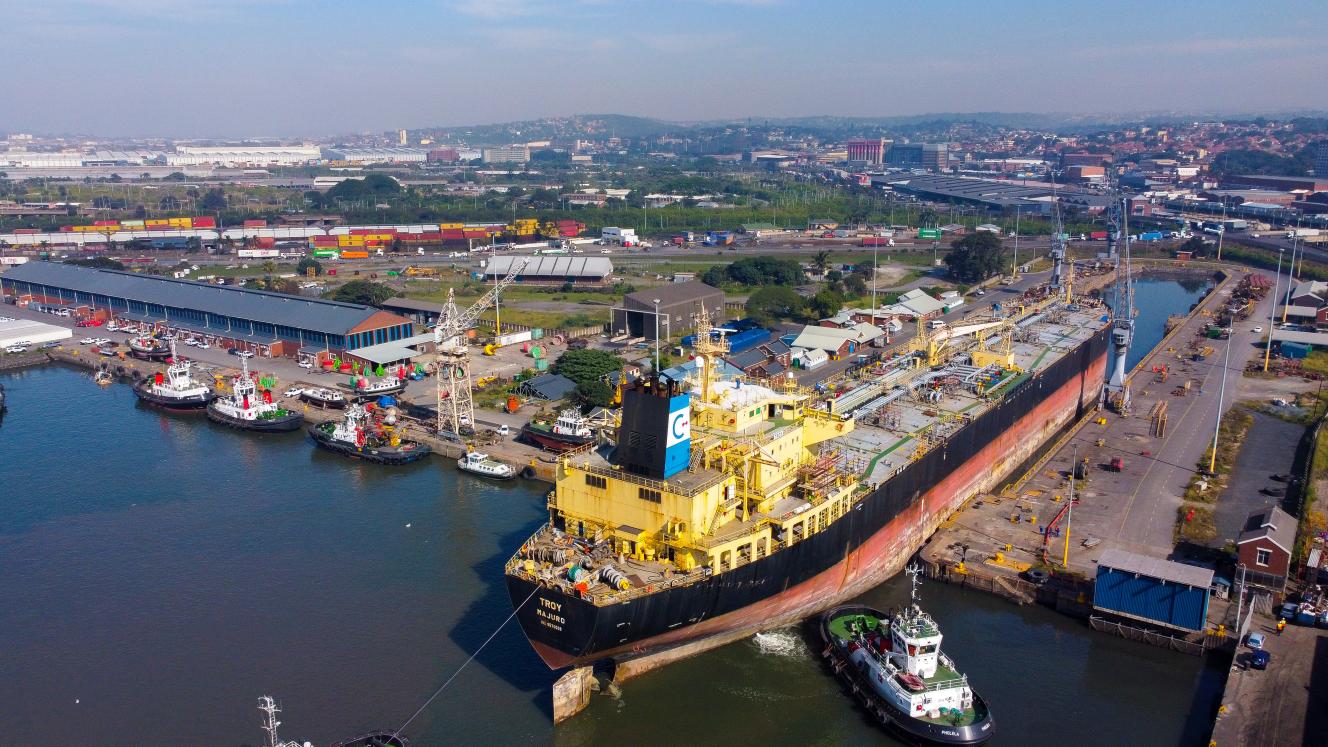
An argument is brewing about alleged moneymaking schemes by Transnet Port Terminals (TPT). It’s a two-fold complaint. One is related to storage fees for breakbulk cargo being applied after the three-day free period, where the extra days are the result of a ship delaying its arrival beyond its original estimated time of arrival (ETA). The second is that longstanding complaint about abnormal truckers being charged for “indirect” landing if a vehicle that was a “direct” landing is not out of the terminal within four hours. A costly problem for these truckers because “indirect” is twice the price of “direct”. TPT has discovered these two contentious means of creating its own revenue at the expense of its clients, according to Carl Webb, MD of Project Logistics Management (PLM) and adviser to the SA Association of Freight Forwarders (Saaff) and the Road Freight Association (RFA) on abnormal transport and port matters. The first, he added, is to open pre-assembly stacks for export breakbulk cargo (three days prior to vessel requirement), and to then charge storage when the vessel does not berth as planned. “They open the stacks, the cargo is delivered into the terminal in good faith, but the client is punished when TPT’s planning does not go according to plan.” Although he acceded that this complaint might have merit, Dave Watts, maritime consultant for Saaff, did stress that TPT had no control over a vessel’s movements while at sea. He also pointed out that the TPT tariff book for 2015 defined the free storage period. “As can be seen see under ‘storage’ on page 33, shipped cargo attracts storage after day three. So, if a vessel goes out (indicates a delay in arrival), storage will probably accrue. I am not sure, but think this has been the case for some time.” Watts did, however, note that the tariff did not include any pricing for bulk or breakbulk landing/ shipping/storage etc, though it did contain the container costs. All charges for breakbulk and bulk are available ‘on application’. “I recollect when this was first introduced there was uproar, as constantly asking for prices for quotes and accounting purposes was problematic,” he said. “The reason given was that multipurpose terminals (MPTs) were in competition with the private sector and did not want to expose their pricing. “This would suggest that, in this case, it would be worth asking the Ports Regulator to act on section 30 (3) (h) Chapter 5 of the National Ports Act (NPA), that requires ‘the filing of prices charged by the provider of any port service other than the Authority’. “That would at least reveal to the regulator just how TPT calculated its charges for this form of breakbulk storage.” Webb described the second alleged moneymaking scheme as “more ingenious”. Abnormal cargo landed directly from the vessel onto a trailer attracts a 50% rebate, he noted, as TPT is then not involved in the handling of the cargo. What TPT does is charge for indirect landing if the vehicle does not depart the terminal within four hours of loading. “This,” Webb said, “is seldom possible as abnormal permits, police escorts and restricted travelling times prohibit the vehicle from departing legally. Yet TPT doesn’t provide parking space for vehicles to go on standby while waiting for all this to happen. “A 50-tonne piece can therefore generate an additional R10 000 odd revenue for the terminal, without them doing anything to earn it. This is a guaranteed source of revenue for them from unsuspecting clients.” Watts was in full agreement with this complaint. “It’s certainly contentious and we have been fighting TPT about this ad nauseam,” he told FTW. The case he made was that TPT was vigorously encouraging the use of Durban as an abnormal unloading point. “But here they are, effectively doubling their charge if you can’t legally get your vehicles out of the port in time.” Watts suggested that if TPT was unable to find the space for the vehicles to wait then that was their problem. “They should provide space if they want to promote Durban as a project cargo delivery point.” INSERT & CAPTION The client is punished when TPT’s planning does not go according to plan. – Carl Webb
TPT ‘moneymaking schemes’ exposed
Comments | 0
© Now Media. This content is protected by copyright and may not be adapted or republished. If you would like to discuss cooperation opportunities, please contact: editor@freightnews.co.za.