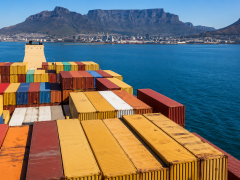
The possibility of the resurrection of some form of liner conferences, or a possible return to an exemption for the liner shipping industry, is currently becoming a hot topic in the freight industry. They first began to face the hangman’s noose as long ago as 1984, but in the European Union (EU) were granted a block exemption from competition laws which lasted until they were finally completely banned in 2006. In SA, a similar scenario unfolded, with the local industry – at that time the Association of Shipping Lines (ASL) – finally giving up its attempts to get a local exemption after its last application to the Competition Commission (CC) in 2006. But conference mutterings are once again being heard, with one example being outgoing Bimco (a major global grouping of shipping lines) secretary-general Torben Skaanild speaking in a personal capacity and saying that container shipping would benefit from the return of the conference system, creating a more controlled and co-ordinated industry. While FTW was busy researching this issue, we were led to believe that it had even gone as far as the SA Association of Ship Operators and Agents (Saasoa) confidentially discussing the subject of conference lines. But CEO Peter Besnard, denied that this was the case. However, our interviews revealed that the anticonference attitude had eased somewhat, although the word “controlled” was applied to any thoughts of a conference resurrection. “I would give a cautious ‘yes’ to a return of some form of conferences,” said maritime legal specialist, Andrew Pike of Van Velden Pike Incorporated. “Whilst there are both advantages and disadvantages to conferences, the advantages seem to outweigh the disadvantages. To the extent that there are disadvantages, an appropriate form of regulation could probably deal with them.” If we want to hedge against the disadvantages, Pike suggested that, if conference lines are to be allowed, they must be subject to some form of regulation. This either by way of say the Competition Commission or a type of “shipping ombudsman”. “The ombudsman,” he added, “would then be empowered to investigate and deal with complaints against conference lines which could, if necessary, be made on an anonymous basis by shippers or by representative groups acting on behalf of individual shippers; to receive and consider all conference and rate agreements and pooling arrangements and determine whether they could result in abuse by a monopoly of shippers; and to regulate tariffs at some level.” Malcolm Hartwell, master mariner and director of Norton Rose Fulbright, also focused on the dangers. “In the main this question relates to the benefits and risks associated with conferences,” he told FTW. “Conferences can bring more regular services which will help shippers and receivers. They may also bring lower rates relating to improved efficiencies in the short term. “The risk, however, is that formation of conferences must, by definition, reduce competition, as a number of lines servicing one trade consolidate to collectively service it. Reduced competition in the free market system generally leads to increased prices in the medium- to longterm and reduced efficiencies. Neither of these is in the interest of shippers. “However, there seems little doubt that they would benefit the owners as they would enjoy economies of scale, consolidated administration and marketing costs and less competition.” Fellow Norton Rose Fulbright director, Andrew Robinson, agreed. “Conferences,” he said, “actually serve the interests of the shipowner.” “The European competition legislators have taken action against the conferences in the past. What is clear is that our Competition Commission would look at any SAbased conference as being ‘uncompetitive’ in nature.” Viewed with the eyes of the shipper, conferences weren’t immediately rejected. But they certainly weren’t promoted, and “control” was once again emphasised. “We have never had any major objections to the conference system per se,” said Mike Walwyn of Seaboard Maritime Services, “but rather to the abuse of the dominant position that it confers on its members. “So, for a conference system to benefit both its members and cargo owners, it would require a strong measure of self-regulation which, given the history of the major players, seems somehow unlikely. “Having said that, I believe that anti-trust legislation and the development of strong competition regulation in most major countries makes it highly improbable that the re-establishment of conferences will ever happen. So, for me, the question is rather academic.” Procurement manager of a major company, Mervin Webb, a member of the SA Shipping Council, expressed his views as “my own personal opinion, with which the SASC may not necessarily agree”. He said: “If lines could reduce the capacity on offer by agreeing who has what percentage of trade to any given destination – and stick to such an arrangement – then they would be in a good position, as business enjoyed would be predictable if not also sustainable. If Joe Public then had to compete for space on the conference vessels to various destinations then the prices could be driven up by the lines. “So, generally speaking, it is not in the interests of the cargo owner that a single conference be in operation. Yes, it brings with it reliability and a reasonable or even excellent level of service, but it tends to stifle competition at the same time and over the longer haul drives up costs. “However, if there is more than one conference, or even single lines plus a conference, to a destination, then competition between the conferences, or conference and individual lines, ensures that competition between the players remains and cargo owners enjoy a reliable service at a good price.” Surprisingly, when FTW talked to two of the biggest lines on the SA trade, neither immediately lauded a possible return to a conference system. • This article has been shortened due to space constraints. For the full version go to www.ftwonline. co.za and click on the ‘FTW continued’ menu item. INSERT & CAPTION 1 The risk is that conferences must reduce competition which generally leads to increased prices and reduced efficiencies. –Malcolm Hartwell INSERT & CAPTION 2 Conferences actually serve the interests of the shipowner. –Andrew Robinson CAPTION Would container shipping benefit from the return of the conference system, creating a more controlled and co-ordinated industry?
The conference conundrum
Comments | 0
© Now Media. This content is protected by copyright and may not be adapted or republished. If you would like to discuss cooperation opportunities, please contact: editor@freightnews.co.za.