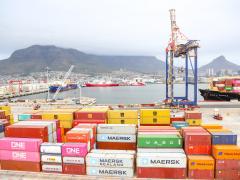
A dip in containership calls at Cape Town may well turn out to be a ‘blessing in disguise’, given the technical gremlins that have considerably delayed commissioning of the first super postpanamax ship to shore gantry cranes. The first pair of R60 million apiece twin-lift cranes dominating the Mother City port skyline have been ready to roll for a while but a considerable hurdle has first to be overcome. Cape Town Container Terminal business unit executive, Oscar Borchards, tells FTW the six-month delay is ascribed to problems at Berth 601, related to ‘strength of the seawall which required anchoring”. Fortunately, he says, the problem was detected at an early stage as it will involve similar work at the other three berths (602, 603 and 604) in the process of rejuvenation. CTCT offers four main berths, so advancing to the next phase until the initial problem has been sorted would make no sense. The global economic downturn accounts for a 7% decrease in Cape Town’s containership traffic but the first four Liebherr twin lift cranes will nevertherless be operational by August 16. These are designed for new-generation vessels capable of accommodating 22 or more boxes across their width. “Once Berth 601 has been handed over, we will start with the next set of cranes (numbers five and six) at Berth 602, to be completed around mid-February 2010, thereafter a further two to take us through to 2012, which will increase the terminal’s capacity to 2.1 million teus.” Dredging to deepen Berth 601 to 15.5 metres was completed recently, the remaining three to follow. Shippers can therefore expect a degree of further inconvenience over the next three years, given that the R4.2 billion project is being tackled piecemeal. The existing four Demag cranes are about as old as containerisation in South Africa, some 30 years, and will be dismantled and sold for scrap. With the introduction of rubber-tyre gantries (RTGs) at CTCT, four existing straddle carriers will be moved over to the port’s multi-purpose terminal and
Technical obstacle stalls commissioning of new CT cranes
Comments | 0
© Now Media. This content is protected by copyright and may not be adapted or republished. If you would like to discuss cooperation opportunities, please contact: editor@freightnews.co.za.