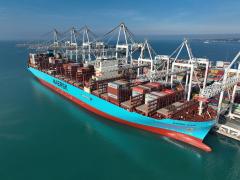
With legislation for the mandatory weighing of containers now approved by the International Maritime organisation for implementation in 2016, the industry is weighing up the best practical options. And according to Kevin Martin, chairman of the Durban Harbour Carriers’ Association (DHCA), the most logical link would be at the straddle carriers at the ports. “We don’t yet know all the undoubtedly various versions of its implementation,” he told FTW. “But in the case of SA, I sincerely hope that Transnet Port Terminals (TPT) will adopt the original IMO proposal of compulsory ‘all up’ weighing by terminal operators.” Martin stressed that costefficiency was what directed your choice of weighing point. “There are a whole lot of links in the supply chain where load-sensing equipment could be installed,” he said. “But these devices are not cheap, and you’ve got to take the overall cost to the logistics industry as a whole into account.” The original loading points “are a no-no”, Martin added. “Everyone would have to have weighing equipment, or use an outside weighbridge. Both expensive items, so a no from a cost perspective.” Weighbridges at the port entrance are out, Martin added, only being good for adding to the already extensive congestion in the Port of Durban’s traffic flow. “For this reason, and the high capital and staff costs, they don’t float the boat.” Axle weight sensors can also be fitted to trailers. “But they’re R100 000-plus a kick, and would push up costs for the road transport industry and its users. It would also mean a separate weighing point for train-transported boxes. All an unnecessary expense.” The ship-to-shore (STS) gantry cranes also have sensors fitted. “But, as Ron Frick, MD of DAL Agency told FTW last week, there’s a whole carriage to ship and loading sequence that would have to be done in reverse if there was an overweight box. So that writes that off.” That leaves the straddle carriers, according to Martin, which all have load sensors as mandatory safety equipment. They are not legally acceptable (only a weighbridge is), but have a close enough accuracy to be a suitable overweight guideline. “And they’re all there already,” said Martin. “All that is required is linking them to the Navis port management system, and Bob’s your uncle. “If so, such ‘official’ weights could be reflected on bills of lading, thereby eliminating confusion in identifying misdeclaration (up or down).” And he also suggested that – to deter those overloadermisdeclarers out there – every overweight, underdeclared box that is found should be reported to customs. “After a misdeclarer finds that every box he sends gets stopped for inspection, he’ll soon change his ways – especially with the fines he would also face,” Martin said.
Straddle carriers 'most logical' for container weighing
Comments | 0
© Now Media. This content is protected by copyright and may not be adapted or republished. If you would like to discuss cooperation opportunities, please contact: editor@freightnews.co.za.