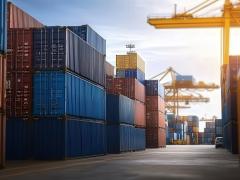
Is there a shipping recovery on the horizon? That’s a vital question at the moment, with the global shipping line sisterhood having gone through a fiveyear recession, and still being financially straitened by an oversupply of tonnage and weak freight rates, and a not-toohappy international trade scene. The answer, according to Safmarine southern Africa cluster manager, Dirk Hoffmann, is yes and no – depending on which market you look at. “While a weakened currency has made SA exports more attractive, it has pushed up the cost of imported goods – and import volumes are down in the face of reduced consumer demand and retailers taking longer to move goods off the shelves and restock,” he told FTW. However, he noted, bucking this trend is Africa, which has shown strong signs of growth. In the medium term, Safmarine expects to see significant growth from the Zimbabwe, Zambia and Malawi markets through the ports of Mozambique, Durban and in some instances, Namibia. It has also seen increased export volumes of tobacco and cotton. Automotive exports and imports have remained consistent year-on-year, according to Hoffmann. “This said, it’s too early to tell the longer-term impact the current industrial action in the auto sector will have on volume performance,” he said. “The European and intra- Africa reefer markets have also shown significant growth during the first five months of 2013. Refrigerated cargo exports to Europe are now back to 2009 levels thanks, amongst others, to a favourable exchange rate and an excellent season.” According to the line’s records, reefer volumes to Europe in the first five months of this year were 25% up on the same period last year. “It is good to see SA growers and exporters being rewarded, this season, after many years of diligently supplying the market with returns under pressure,” Hoffmann said. “Reefer volumes have increased, in particular to the UK, Netherlands and Russia, and in Africa to Benin, Ghana, Nigeria, Senegal and Togo.” He also pointed out that the Middle East region also continued to show steady growth for perishable cargo, and that fruit was now moving directly into the mainland Chinese ports. “We’ve seen a dramatic shift in volumes away from Hong Kong for grapes and citrus directly into the other Chinese ports such as Nansha, Yantian and Shanghai,” Hoffmann said. Matt Conroy, Maersk Line’s trade and marketing manager, believes demand is still not overly strong to support a recovery. “Maersk Line improved results are a reflection of improved operational efficiencies (resulting in lower fuel spend), rather than an increase in freight rates and volume,” he told FTW. INSERT & CAPTION In the medium term, Safmarine expects to see significant growth from the Zimbabwe, Zambia and Malawi markets. – Dirk Hoffmann
Shipping recovery - yes or no?
Comments | 0
© Now Media. This content is protected by copyright and may not be adapted or republished. If you would like to discuss cooperation opportunities, please contact: editor@freightnews.co.za.