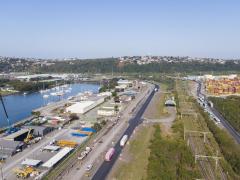
Alan Peat THERE IS indisputable logic behind the siting of the new SA Transport Investment (SATI) container depot some 25-kilometres south of the Port of Durban, according to depot g.m. Mark Holbrook. “The primary reason for establishing the depot is that SATI is part of the Maersk Sealand group - including Safmarine - and we wanted our own site.” However, there was no suitable land area available in the harbour area. “We were therefore left with the choice of going north, west or south of Durban,” said Holbrook. And with the south coast area being the home for most of Durban’s industry, connected in all directions by a good highway network, and served by rail, the site chosen was the best option. The initial development is a totally paved area of 40 000 square metres, with 13 000 sq.m. as yet undeveloped. Sati is acquiring a further 15 000 sq.m. at the end of the month. It has room for 3 500 containers, stacked 6-high with its 45-ton reach stacker and three other container handling machines; a full-scale workshop; a huge washbay for 120 TEUs (twenty foot equivalent units); a pre-tripping area for 80 boxes; a rail siding for 20 rail trucks; a state-of-the-art foaming machine, so the depot can handle major structural repairs to containers; and the latest depot management system. “We’re working two shifts at the moment,” said Holbrook, “although we’re on-call all night if required. “However, by the end of this month (March), we will move up to a 24-hours-a-day operation.” The depot’s in-bond licence is also expected any day. Said Holbrook: “What we’re trying to point out to transporters is that - although we’re further away than the current in-port depots - we have a turnaround time mostly of less than 10-minutes, as opposed to the wait of up to an hour at the other depots. “And this highly efficient turnaround, and the ease of access from three highway routes, makes up in time for what is lost in distance.” Holbrook also thinks it is good long-term thinking. “I think the current depots will also have to move out of the port area,” he said, “as the space they presently have comes more and more under pressure. “Such a space constraint will never be a problem for this depot.” Colin Lambourne, area executive for Safmarine in Kwa Zulu Natal, agreed. “Until now we’ve been using four or five other multi-line depots, with all the problems of slow turnaround, and in congested traffic areas of the city. “Indeed, we’ve just had one client join us purely because of these delays in the other depot areas.” The dedicated depot can also meet the group’s growth in the long-term, he added. “The current depots are going to struggle to go for the same growth,” Lambourne said, “with the limited space available to them.” Having all these facilities and space under one roof in its own depot is a bonus for the group, according to Maersk Sealand’s regional executive, Nick Gough. “As to location,” he said, “I’d weigh up the possible disadvantage of distance against the very fast turnaround. “Trailers can be turned around quicker than any other depot in Durban, and it’s out of the congested city area, and on an open road system. “Although it’s further away, it’s actually quicker.” Lambourne also suggests that truckers should start to get clever, and start to triangulate their operations better. “The triangular focus is what’s needed. “It’s working smarter in my opinion - not just thinking port-to-depot.”
Sati’s speedy turnaround pulls in Durban customers
Comments | 0
© Now Media. This content is protected by copyright and may not be adapted or republished. If you would like to discuss cooperation opportunities, please contact: editor@freightnews.co.za.