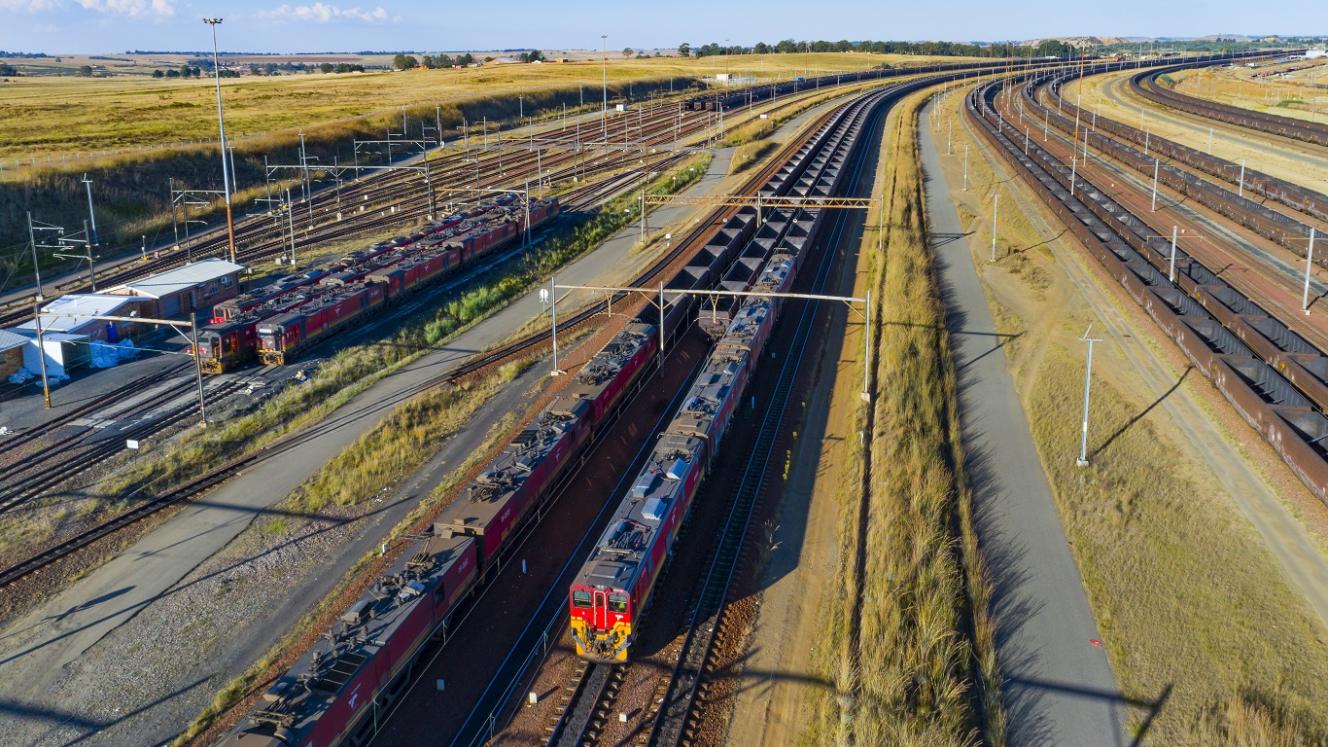
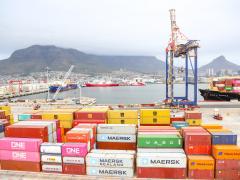
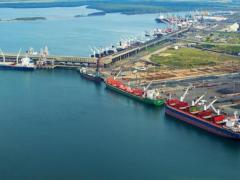
Clients would be guaranteed 24-hour service Ray Smuts THE PORT of Saldanha's relatively new after hours marine services surcharge could soon be a thing of the past as iron ore exporters are asking National Ports Authority to switch over to a Ôflat rate' instead. The request currently under consideration has come from iron ore exporters, who ship around 80% of total volumes handled through the port. Port manager Eugene Kearns confirmed to FTW last week that a flat rate was "close to being offered" but it would ultimately be up to clients to decide whether or not these considerably higher rates were acceptable. The port normally works a 12-hour day, and the after-hours surcharge of R10 000 per vessel effective from May this year guarantees round-the-clock marine services. Even though it has operated without a hitch thus far it seems the reason for cargo owners seeking firmer assurances is that in exchange for the flat rate they will be guaranteed a 24-hour service. This bearing in mind that the intention is to increase current iron ore export volumes of 23 million tons to 38 million a year within an unspecified time frame. It is thought the logic behind the flat rate is that as things now stand a ship owner, through his agent, could effectively avoid paying the R10 000 surcharge by delaying docking till normal hours prevail, although it must be emphasised such a practice has not yet occurred. "The cargo owners certainly do not want delays of that nature to happen, particularly if berths are available and the product ready for loading," says Kearns. Saldanha's marine service complement stands at around 100 but implementation of the flat rate would mean increasing the work force by around one-third to ensure an effective 24-hour operation. In order to be able to handle the proposed iron ore export volumes South African Port Operations is in the midst of a three-year, approximately R630 million, expansion and refurbishment programme at the iron ore terminal. Much of the equipment dates back to the mid-1970s and the new SAPO shopping list will include ship loaders, an additional conveyor system and a new stacker. It does not follow that ports handling so-called Ôdirty' cargo are necessarily dirty, hence Kearns' determination to have ISO14000 - an international environmental standard - in place before the end of 2003. "Iron ore is the backbone of the economy of many countries and even if it is labelled as so-called dirty cargo that does not imply one cannot manage it responsibly in order to co-exist with other cargo." Saldanha plays host to some 400 ships a year of which approximately half call to load iron ore, the remainder comprising tankers, break bulk and multi-purpose vessels.
Saldanha considers switching from surcharge to flat rate
Comments | 0
© Now Media. This content is protected by copyright and may not be adapted or republished. If you would like to discuss cooperation opportunities, please contact: editor@freightnews.co.za.