The success of a fixed-day departure schedule for any shipping line depends mainly on speed of turnaround in ports of call. Veteran shipping journalist Paul Clegg reports on a voyage between the UK and South Africa aboard Safmarine's S.A.Helderberg. Between northern Europe and South Africa the ships on the present SAECS schedule call at ten ports over a distance of some 7 700 nautical miles, on a voyage taking up to 21 days. It is essential, therefore, that not only should a ship be allocated a berth immediately on arrival, but also that she be worked as fast as possible while alongside. Shippers depend on it. At all ports on this voyage the ship berthed on, or close to, arrival except at Port Elizabeth and Durban, the reasons for which are outlined later.
At north European ports, speed of discharge and loading varied. Tilbury was the slowest with 14.6 lifts per gang/hour during time actually worked (this is the net rate; the gross rate being based on time taken from start of loading to completion of discharge). That said, a one-hour count, arbitrarily chosen by the author, saw 20 lifts. The fastest was Bremerhaven with a very commendable net rate of 22 per g/h. During a one-hour count here one gang achieved 31 moves. Rotterdam and Le Havre were also effective, shifting 18.8 and 19.2 per g/h respectively. Calls at the Canary Islands terminals of Santa Cruz de Tenerife and Las Palmas, introduced in May 1998, marked a significant change in SAECS' activities. Although the number of boxes shifted at Santa Cruz is the lowest on the itinerary, calls here are considered worthwhile because of the increasing potential of the fruit business. Speed of handling at both ports was excellent at 23.4 for Santa Cruz and 25.7 for Las Palmas.
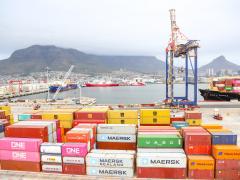
Incentives haven't kicked in And so to Cape Town, the first port of call in South Africa. Comparisons with ports further north immediately became apparent. The net rate of handling here was 12.6 lifts per gang/hour. The recently introduced performance incentives for dock workers have clearly not yet had their impact on speed of handling here.
Go-slow
A 'go-slow' at Port Elizabeth resulted in the ship being held at anchor from 05:00 to 19:18 on 24 September. According to Portnet's container manager Eddie Hill, a reduction in the number of reserve gantry and straddle carrier drivers had been part of the original performance agreement with the unions, but dock workers were taking their own action. The resulting rate of handling was down to 10.9 per g/h, which was ironic because in the opinion of the ship's officers, Port Elizabeth is usually one of the fastest.
The six-hour delay berthing delay at Durban was a one-off situation, because the duty pilot rostered to bring the ship in had fallen sick at the last moment. An overall handling rate could not be calculated here, because the author left the ship before completion, but a one-hour count revealed a figure of 22 per gang/hour. The norm here is usually about 17 per g/h and increasing. In August, the port achieved its record throughput in one month of 105 000 teu.
In conclusion, it seems that most ports are meeting expectations, and schedules accordingly are being maintained.
l (Author's Note: The above takes no account of the new SAECS schedules, but the ports of call are still used)
Copyright Now Media (Pty) Ltd
No article may be reproduced without the written permission of the editor
To respond to this article send your email to joyo@nowmedia.co.za