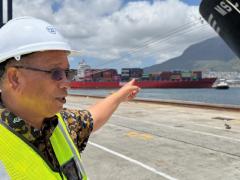
South Africa has lost and will continue to lose trillions of rand in earnings as the country turns a blind eye to the potential lurking in the ships’ bunker fuel industry, according to Haydn Lockhart-Barker, chairman of the International Bunker Industry Association (IBIA), Southern African branch. SA ports' “exorbitant” berthing fees, and no berthing priority, means the bunker-hungry ships out there sail on to other more economically priced and customer-friendly fuelling points. Quoting a report done in 2006 by Professor Trevor Jones, head of maritime studies at the University of Kwa Zulu Natal, Lockhart- Barker added: “Some say that Durban is amongst the 10 most expensive ports in the world. But we say, from a bunkering point of view, it is THE most expensive. “Excluding fuel oil expenditure, these ships release between R2-R4m a day in commercial activity – in crew as well as ship logistics-related expenses. Hotel, airline, taxi and ship repair industries could be amongst the recipients.” Now, the removal of pipeline facilities in the Port of Durban – as well as only prioritising the container vessel market, with the resultant lack of berth availability for “bunkers only” vessels – have exacerbated an already precarious situation. And the ship operators rely on a quick turnaround time as ship operations are very costly, he added. Another problem is the composition of ships’ bunker fuel currently available in SA. “Generally speaking most ships burn a 380cst (centistoke) because it’s cheaper,” he said. “But, due to various reasons, the fuel we produce, although of a higher quality, is a 180cst, and is therefore priced higher.” And pricing is an issue. The traditional “bunkers only” market mainly comprises dry cargo operators plying the trades between South America and Asia, according to Lockhart-Barker, with SA perfectly and strategically positioned almost right in the middle. “But Argentina has developed a liberalised market economy on the supply of bunker fuel, and has developed a safe offshore bunkering facility in an area referred to as the Common Zone,” Lockhart-Barker said. And “on-the-day pricing” when this interview took place, showed that the Buenos Aires pricing of LS 380cst was US$595 per metric tonne “delivered”. This meant an all-inclusive price, plus a small agency handling fee compared to Durban’s US$626/mt for high-sulphur – plus US$11.10 for barging. “Add to that upwards of US$20 000 port calling costs and it makes SA a wholly uncompetitive market,” he added. “So, if you talk about developing the SA market, the fact that the ownership of the bunker fuel infrastructure in these ports is unable to store imported product or deliver the fuel the market requires is a major stopper.” But, according to the IBIA, there is an opportunity to awaken this now slumbering SA bunkering industry. Since 1997 the bunkering turnover per year has been halved from 2.2 million tonnes to 1.1m tonnes. That’s over 900 ships a year lost to the SA market. “In 2013, a Handysize vessel coming in for bunkers at the Port of Durban would incur port costs in excess of US$15 000 per day, compared to US$1 200 per day in 2000,” Lockhart-Barker said. “Now, these vessels also receive the lowest priority by the port authorities. Add the cost of fuel and the barging, then you arrive at a point where it doesn’t make any economic sense for ships to refuel at any of our ports. “In essence, the shipping market changed, but the SA players just couldn’t read it.” Realistically, the market now demands an additional “outside port limits” (OPL), offshore bunkering facility, he insisted. The success of the West African offshore refuelling market and many others bears testimony to the fact that safe and efficient shipto- ship transfer worldwide is the correct model to follow. This is something IBIA supports, as it has been involved in setting up similar “best practice” operations in the ports of Singapore and Gibraltar for precisely this reason. They believe that, by setting up legislated bunker procedures, in combination with all private and public stakeholders, cooperation is the way forward. There are already a few local options to consider. “We believe the country as a whole would benefit if the market was opened up in a thoughtful and regulated manner, especially with regard to capitalisation of the previous disadvantaged groupings, which are hugely underrepresented in this sector. SA is crying out for input for joint ventures between local and foreign operators,” said Lockhart- Barker. The IBIA also wants the government to have a strong look at doing offshore bunkering. As an example, Gibraltar, which also has a regular passing trade as ships sail in and out of the Med, sells 4.9 million tonnes a year – from selling nothing ten years ago. INSERT & CAPTION From a bunkering point of view, we believe Durban Port is THE most expensive in the world. – Hayd0n Lockhart-Barker
SA port costs drive away bunker business
Comments | 0
© Now Media. This content is protected by copyright and may not be adapted or republished. If you would like to discuss cooperation opportunities, please contact: editor@freightnews.co.za.